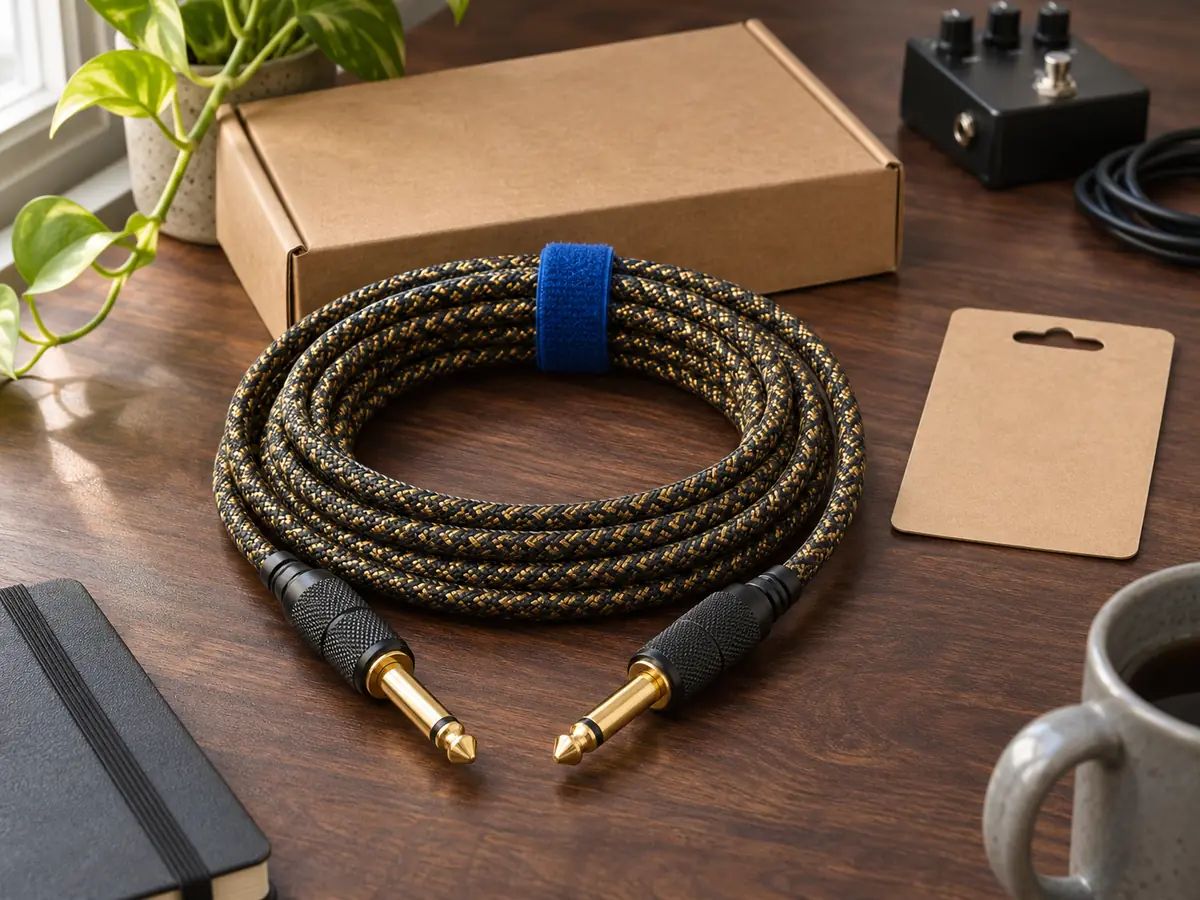
| Fact | Details |
|---|---|
| Who this guide is for | DTC audio brands, music retailers, and distributors launching a store-brand instrument cable line |
| Core product | 1/4" (6.35 mm) TS instrument cable: unbalanced, mono, two contacts |
| Specs to fix in writing | Conductor, shielding, conductive layer, jacket, connectors, length and tolerance, packaging |
| What drives MOQ | Raw cable runs, connector housings, logo method, and packaging print runs |
| Documents buyers commonly request | RoHS and REACH test reports (EU), a Prop 65 assessment (California), and product safety label information for EU consumer sales |
| Who is responsible for compliance | Usually the brand that sells the product under its own name, not automatically the supplier |
What should you decide before you contact a supplier?
Decide who the cable is for, how many SKUs you will launch, and what price tier you are aiming at. Those three choices drive almost every specification and cost decision that follows.
A first range usually needs fewer SKUs than founders expect. A common starting point is one cable construction offered in two or three lengths, with straight-to-straight and straight-to-right-angle plug options. You can add patch cables, colorways, and premium versions once you know which SKUs sell.
Answer these questions before you request quotes:
- Who is the player? Gigging musicians care about durability and handling noise. Home players care about looks and price. Studio buyers often ask about capacitance.
- Where will you sell? Your own online store, marketplaces, or retail shelves each need different packaging and labeling.
- Which markets? The EU, the UK, the US, and other markets have different documentation and labeling rules.
- What makes your cable different? A colorway, a plug style, fully published specs, or simply a better-looking package. Pick one or two points you can prove.
- What is your target retail price? Work backward to a landed cost that includes freight, duties, packaging, and marketplace fees.
If you are not yet sure which cable types belong in your range, our guide to TS, TRS, and XLR cables explains the differences.
Which guitar cable specs should your spec sheet cover?
Your spec sheet should define every part of the cable that a buyer can see, hear, or measure: conductor, shielding, conductive layer, jacket, connectors, length, and packaging. Anything left unwritten is decided by the supplier, and it may change between the sample and mass production.
| Spec item | What to define | Why it matters | Proof to request |
|---|---|---|---|
| Center conductor | Material (for example, oxygen-free copper or tinned copper), gauge in AWG, strand count and diameter | Affects flexibility, durability, and resistance | Supplier datasheet; material confirmed in writing on your order; an independent lab test, at your cost, if you need proof of a special copper claim |
| Insulation | Material (often PE or foamed PE) and thickness | Main factor in capacitance, together with the cable's dimensions | Supplier datasheet |
| Conductive layer | Present or not; material (often conductive PVC or a carbon layer) | Reduces handling noise when the cable moves | Datasheet and a cross-section photo |
| Shield | Braided or spiral (served); material; coverage if you plan to publish it | Affects interference rejection, flexibility, and durability | Datasheet; braid calculation or measurement for any coverage figure |
| Jacket | PVC, TPE, or textile braid over an inner jacket; color or pattern; outer diameter and tolerance | Look, feel, coiling behavior, and plug fit | Color card or physical swatch; datasheet |
| Connectors | 1/4" TS straight or right-angle; housing material; contact plating; strain relief type | Durability, fit in pedals and amps, and appearance | Drawing or photo; plating specification |
| Termination | Soldered or other method; how the shield is terminated | Long-term reliability | Photo of an opened plug from the sample |
| Capacitance | Measured value in pF/m (or pF/ft), with the test method | With passive pickups, long or high-capacitance cables reduce treble | Measurement report stating conductor-to-shield and test frequency |
| Length | Nominal length, tolerance, and how length is measured | Retail labeling accuracy | Written tolerance on the spec sheet |
| Packaging | Tie, bag, header card or box; barcode position; carton quantity | Retail presentation and shipping protection | Printed proof and a packed sample |
Conductor and gauge
State the conductor material exactly as it appears on the supplier's datasheet. If the datasheet says oxygen-free copper (OFC), make sure your order confirms "OFC" in writing before you print it on your box. If you need proof for a retailer or marketplace, commission an independent lab test of a production sample at your own cost. Avoid purity grades or special copper claims that are not confirmed in writing on your order.
Shielding and the conductive layer
Instrument cables use either a braided shield or a spiral (served) shield. Braided shields hold their coverage when the cable is flexed and stand up well to stage use, but they are stiffer and cost more to make. Spiral shields are more flexible and easier to terminate, but the wires can spread apart when the cable is bent repeatedly, which opens gaps in coverage. The crackle you hear when a cable moves or is stepped on is handling (triboelectric) noise, generated where the insulation rubs against the shield. A conductive layer between the insulation and the shield reduces it, so it is worth specifying for a cable aimed at gigging players.
Capacitance
Capacitance is the electrical property most guitarists ask about. A passive guitar pickup and cable form a circuit in which higher total capacitance can soften high frequencies, especially on long runs. Publish a capacitance figure only if it was measured, and state how it was measured. For a full explanation, see our guide to instrument cable capacitance.
Connectors
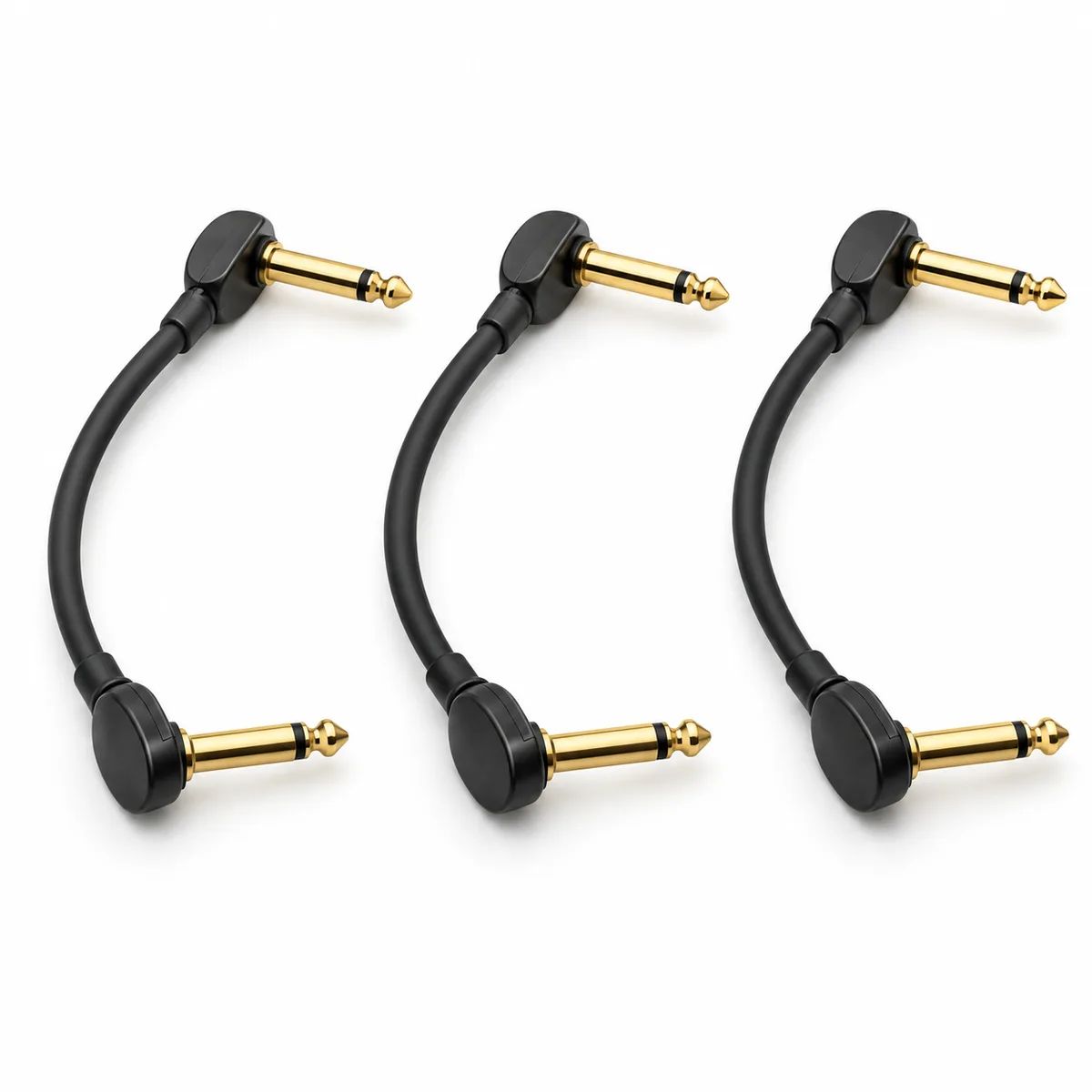
Decide on straight or right-angle plugs, the housing finish, and the contact plating, and write one choice per SKU. Do not use third-party connector brand names on your packaging or listings unless the connectors are genuine and you can show proof of purchase. If you sell pedalboard patch cables later, plug thickness and spacing matter as much as cable quality. See our pancake patch cable page for the specs that matter on a pedalboard.
Length and tolerance
Define the nominal length, the tolerance, and the measuring method (for example, tip to tip). Pay attention to unit conversions: 3 m is about 9.8 ft, so a cable sold as "10 ft" should actually measure at least 10 ft. Mislabeled lengths are a common source of marketplace complaints.
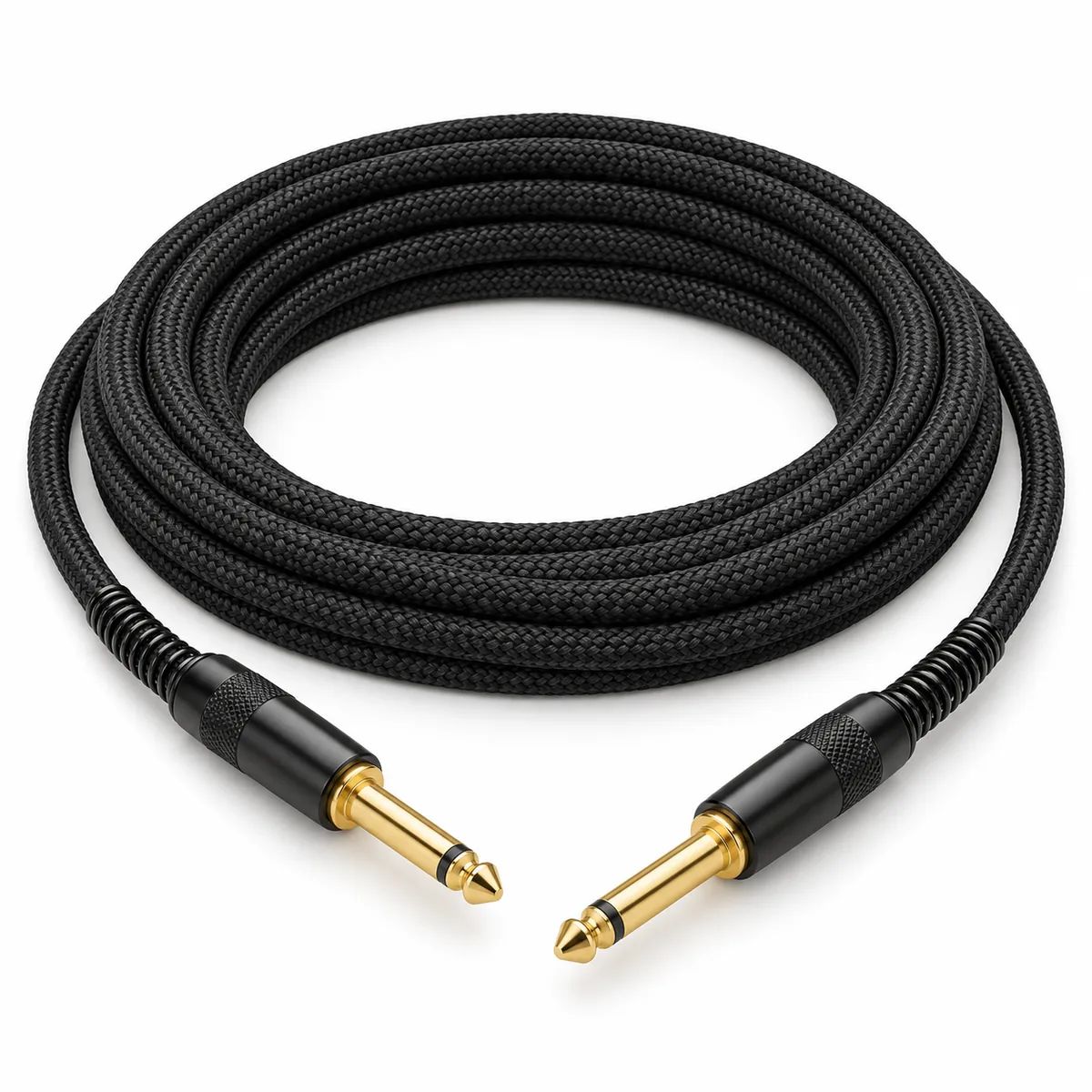
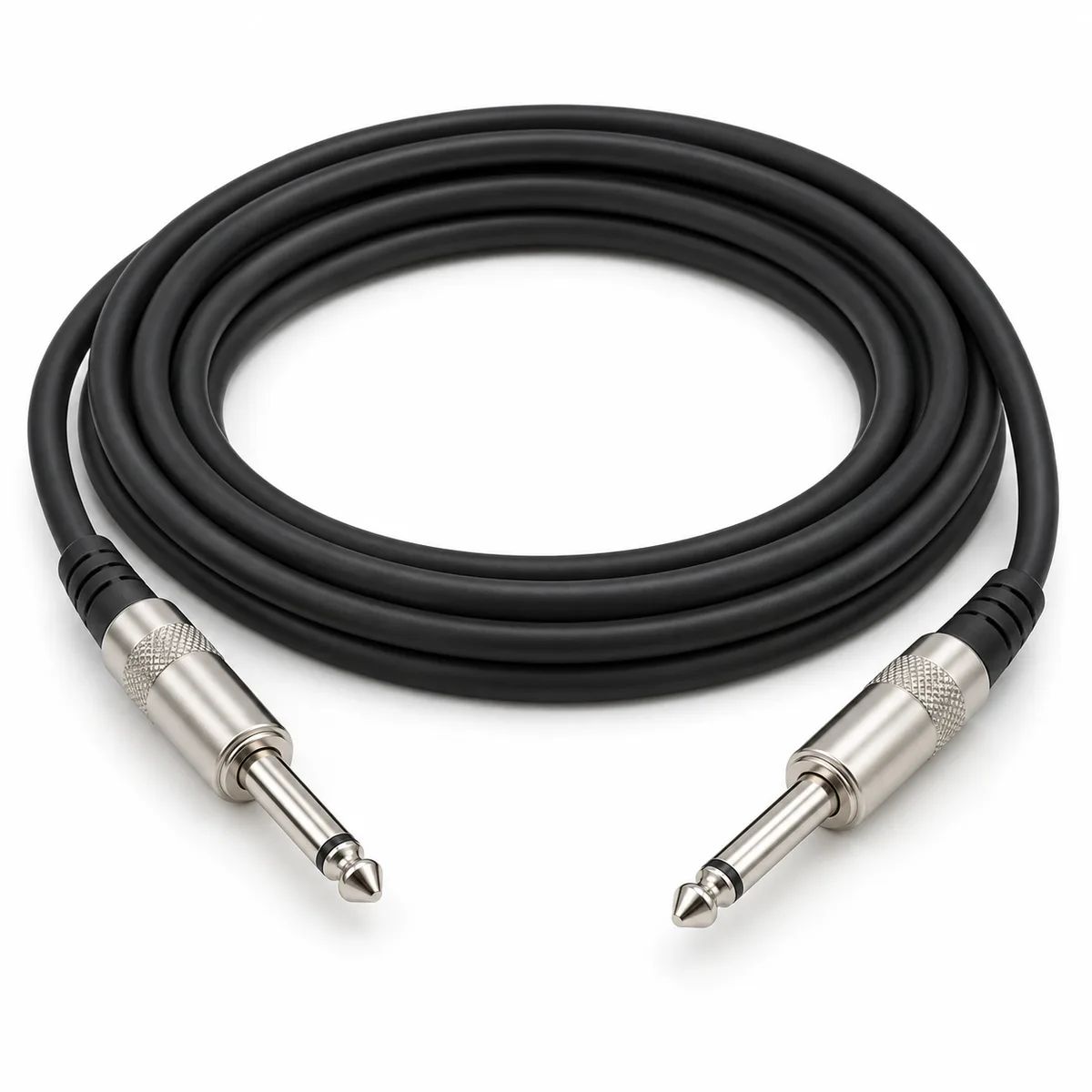
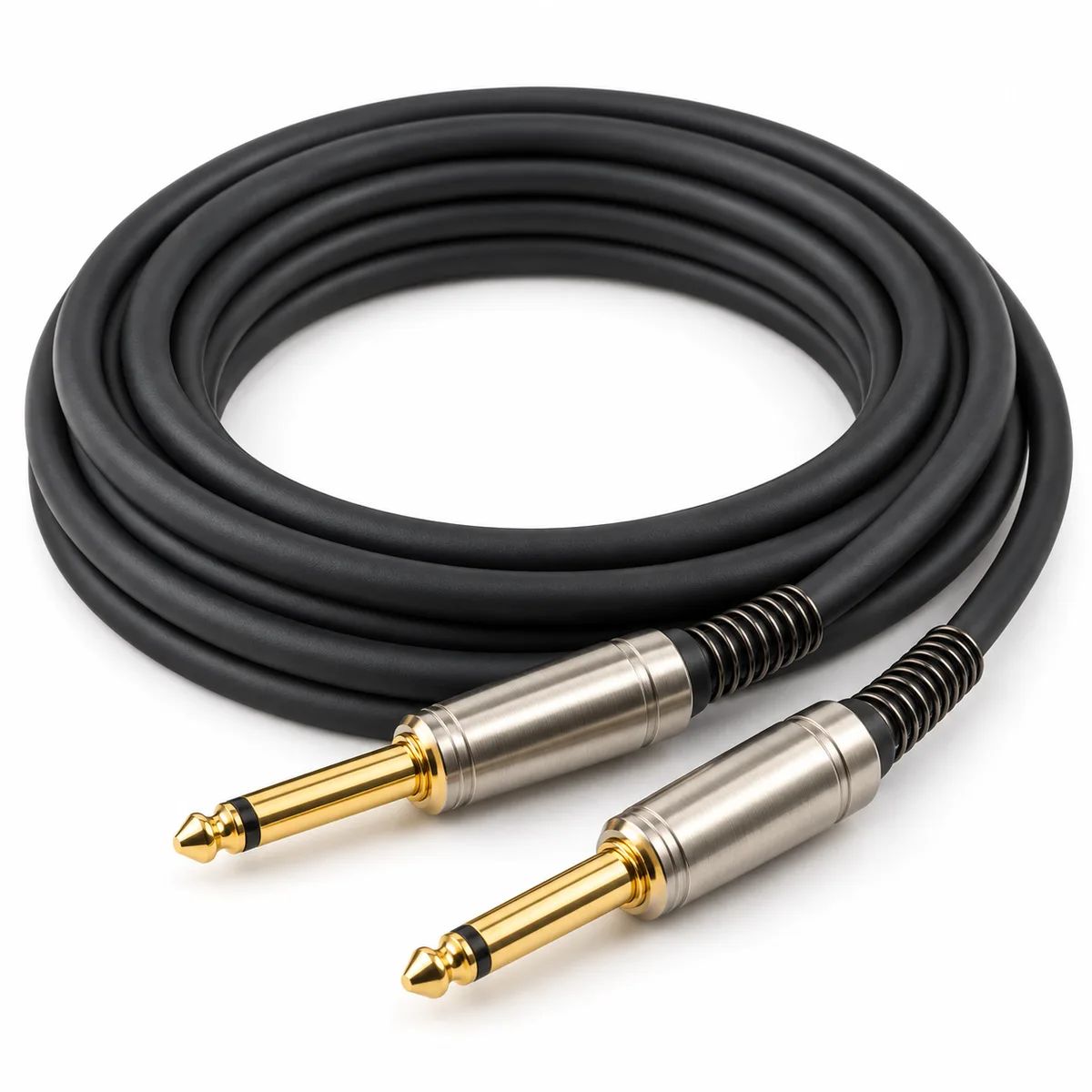
If you want to see how these items look on finished products, browse our instrument cables and the braided instrument cable, standard PVC instrument cable, and heavy-duty instrument cable pages. A downloadable spec template is covered in our guide to writing a cable spec sheet.
How do MOQs work for a private-label guitar cable?
The minimum order quantity (MOQ) for a private-label guitar cable is set by the component with the largest minimum run, not by the finished cable. Custom jacket colors, custom connector housings, and printed packaging each have their own production minimums. Using stock components wherever possible is the fastest way to start smaller.
| Customization level | What changes | What usually drives the minimum | How to start smaller |
|---|---|---|---|
| Logo on stock design | Your logo laser-engraved or printed on stock plugs; stock cable and packaging | Setup for the logo process, and the supplier's minimum for the stock item | Keep one plug finish across all SKUs so one logo setup covers the range |
| Custom colors or braid patterns | Jacket color or textile braid pattern made for you | Minimum run of the cable jacket or braid | Choose from the supplier's existing colorways first |
| Custom packaging | Printed header cards, boxes, or sleeves | Print run minimums per design | Use one box design with a SKU sticker for length and plug options |
| Custom connectors | New housing shape or molded parts | Tooling and the first production run of the part | Launch on stock housings; tool your own part after the range proves itself |
Practical ways to keep a first order manageable:
- Limit SKUs. Two lengths and two plug combinations already make four SKUs per colorway.
- Share components. Use the same cable and plug across SKUs so that minimums are spread across the whole order.
- Separate brand from product. Put your brand on the plug and the packaging, not on a custom jacket, for the first run.
- Ask about mixed orders. Some suppliers allow different lengths or colors to count toward one order minimum. Ask in writing.
At Haisen, MOQ depends on the cable type, length, and level of customization, and we confirm it in your quote. You can combine lengths and colors toward one order minimum; the per-order and per-SKU minimums are stated in your quote. For your logo, choose the method that suits your product: laser engraving, pad printing, metal badges, heat-shrink printing, jacket printing, printed hook-and-loop ties, or custom-tooled housings. Our stock braid colorways are black, black/red, black/white and tweed, and custom braid colors can be matched to your Pantone reference. Packaging options include polybags with header cards, color boxes, kraft boxes, gift boxes, pouches and tins; see our OEM and private-label page for the full list.
What packaging does a retail-ready guitar cable need?
A retail-ready guitar cable needs a tie or wrap, protective packaging, a label or insert that identifies the product, a scannable barcode, and a country-of-origin marking where the destination market requires one. Marketplaces and retailers may add their own labeling and carton requirements.
Plan these items together with your designer and supplier:
- Product identification. Brand, product name, length in the units your customers use (for example, 10 ft (3 m)), plug configuration, and model or SKU code.
- Barcode. Retail barcodes (UPC or EAN) should come from GS1 or a GS1 member organization, registered to your company. Each variation, such as a different length or color, needs its own number. Your supplier applies the barcode you provide; it should not issue one for you.
- Country of origin. The US, for example, generally requires imported articles to be marked with their country of origin in a legible and permanent way. Check the rules for each market you sell in.
- Safety and contact information. For consumer sales in the EU, product safety rules require certain identification and contact information on the product, its packaging, or an accompanying document. See the compliance section below.
- Warnings, if they apply. For example, a California Proposition 65 warning if your assessment shows one is needed.
- Shipping protection. Inner packs and master cartons sized so that coiled cables do not crush, with carton marks your logistics provider or marketplace requires.
If you sell online through a marketplace, check its current packaging and labeling requirements before you approve printed packaging. Requirements change, and reprinting boxes is expensive. Haisen can apply the GS1 barcodes you provide, attach Amazon FBA labels, and mark master cartons to your instructions. We can also print the EU product safety details you supply on labels or packaging, but we do not act as your EU responsible person.
Which compliance documents should you have on file?
Most brands selling guitar cables in the EU and US keep test reports for restricted substances (RoHS and REACH), an assessment for California Proposition 65, and the product identification and contact details required for consumer products in the EU. The brand selling under its own name is typically the party regulators expect to hold these files.
Important: This section is a general overview for planning purposes, not legal advice. Requirements depend on your product, your role in the supply chain, and each market's current rules. Check the official texts and confirm your obligations with a qualified compliance advisor.
| Market | Rule | What it covers (in brief) | What brands commonly keep on file |
|---|---|---|---|
| EU | RoHS Directive 2011/65/EU, as amended by Delegated Directive (EU) 2015/863 | Restricts 10 substances, including lead, cadmium, and four phthalates, in electrical and electronic equipment; the directive's scope includes cables | A RoHS test report that names your model, the lab, the report number, and the date |
| EU | REACH Regulation (EC) No 1907/2006 | Chemicals in articles; duty to inform customers when an article contains a Candidate List substance (SVHC) above 0.1% by weight; some substances are restricted under Annex XVII | An SVHC test report stating which Candidate List update it covers; reports covering restricted plasticizers in PVC parts |
| EU | General Product Safety Regulation (EU) 2023/988, applicable from December 13, 2024 | Safety of consumer products; product identification, manufacturer details, and an EU-based economic operator for many products | Your technical documentation, product identification scheme, and the details printed on product or packaging |
| US (California) | Proposition 65 | Businesses with 10 or more employees must give a clear and reasonable warning before knowingly exposing people in California to listed chemicals | A Prop 65 assessment or test results for parts such as PVC jackets and brass connector components, and a decision on warnings |
| US | Country-of-origin marking (19 CFR Part 134) | Marking of imported articles with their country of origin | Approved artwork showing the origin marking |
A few practical points:
- Ask for reports by model. A report for "audio cable" in general does not prove that your configuration complies. The report should name the model or describe the materials it covers.
- PVC and brass deserve attention. Plasticizers in PVC jackets and lead in brass connector parts are frequent topics in restricted-substance testing. Ask what was tested.
- Avoid loose certification language. Phrases such as "certified" or "approved" imply third-party certification. For passive cables, describe the test report you hold instead, and ask your compliance advisor which marks apply to your product, for example whether CE marking is required in the EU.
- Protect your brand name. Search existing trademarks and consider registering your mark in your main markets before you print packaging. The USPTO and EUIPO publish starting guides.
We can arrange RoHS testing, and CE or FCC testing where applicable, for your configuration on a per-project basis, with reports issued for your brand. You remain the responsible brand for the products you sell, and we do not act as your EU responsible person. See our compliance page for how we handle documents.
How should you approve samples and the first production run?
Approve a sample against your written spec, sign off on one unit as the golden sample, and use that sample as the reference for checking mass production. Without a signed-off reference, disagreements about color, length, or plug fit are hard to resolve.
A simple sample review for guitar cables:
- Check against the spec sheet. Measure the length, check plug type and finish, and compare the jacket color with your swatch.
- Test continuity and shorts. Use a cable tester to confirm the tip and sleeve are connected correctly and are not shorted.
- Listen for handling noise. Connect the cable between a passive guitar and an amp at a moderate volume, then move, tap and gently step on the cable. Compare with a cable you already trust. Excessive crackle points to construction or termination issues.
- Open one plug. If the housing unscrews, look at solder joints, strain relief, and how the shield is terminated. For molded plugs, ask the supplier for a cut-open sample or photos.
- Flex the cable near each plug. Flex it while listening or while monitoring continuity. Strain relief failures and intermittent contacts usually show up where the cable meets the housing.
- Check packaging. Scan the barcode, read every line of printed text, and confirm the carton marks.
- Keep the golden sample. Label it, date it, and keep one at each end if possible.
Before shipment, the order should be checked against the golden sample. Agree in writing who performs that check, what is inspected, and what happens if defects are found. On Haisen orders, every bulk order is checked before shipment by Haisen staff or a third-party inspector we appoint, using AQL sampling, and we send you the report and photos. If you prefer your own independent check, you can also book a third-party inspection company at your cost.
Guitar cable brand launch checklist
| Stage | Checklist item | Done |
|---|---|---|
| Plan | Target player, sales channel, and markets defined | ☐ |
| Plan | Range limited to the SKUs you can sell through | ☐ |
| Plan | Trademark search completed for your brand name | ☐ |
| Spec | Sheet covers conductor, shield, conductive layer, jacket, connectors, length and tolerance, packaging | ☐ |
| Spec | Every published claim (material, capacitance, coverage) backed by a document | ☐ |
| Quote | States price breaks, one-time costs, sample terms, lead time, trade terms, and payment terms | ☐ |
| Sample | Checked against spec; golden sample signed off and stored | ☐ |
| Packaging | Barcodes from GS1 registered to your company; origin marking; required safety information | ☐ |
| Compliance | RoHS and REACH reports matched to your model; Prop 65 decision made; EU labeling details confirmed with an advisor | ☐ |
| Production | Pre-shipment check agreed in writing, with a defect process | ☐ |
| Launch | Listing specs match the spec sheet and packaging exactly | ☐ |
Ready to put a brand on your first cable run? Our solutions for DTC audio brands and solutions for music retailers and studios explain how we work with each type of buyer.
FAQ
How much do I need to order to start a guitar cable brand?
It depends on how much you customize. A logo on stock plugs with stock cable and packaging usually has the lowest minimum. Custom jacket colors, custom connector housings, and printed boxes each add their own production minimums. Ask suppliers to quote each customization level separately so you can compare. Our quotes state the minimum for each level.
Do I need my own barcodes for private-label guitar cables?
Yes, if you sell through retailers or most marketplaces. Retail barcodes should be licensed from GS1 or a GS1 member organization and registered to your company. Each variation, such as a different length or color, needs its own number. Your supplier can apply the barcodes you provide.
Which compliance documents should a guitar cable brand keep?
For the EU, brands commonly keep RoHS and REACH test reports that name the model, plus the product identification and contact details required for consumer products. For California, brands make a Proposition 65 assessment. Requirements vary by market and change over time, so confirm yours with a qualified compliance advisor.
Should I advertise capacitance on my packaging?
Only if the figure was measured on your cable and you can state how it was measured, for example conductor to shield at a given frequency. A capacitance number without a test method is hard to defend if a customer or retailer asks for proof.
Can I use a well-known connector brand name on my cables?
Only if the connectors are genuine and you can show proof of purchase. Even then, follow the brand owner's trademark guidelines. Generic descriptions such as "zinc-alloy 1/4-inch TS plug" are safer when you are not using branded parts.
Regulatory summaries in this article are general information; the official texts below prevail.