Supply chain and quality control
How we specify each order, approve the golden sample and inspect every bulk order before it ships.
RoHS and REACH testing, plus CE or FCC where applicable, arranged per project with reports issued in your company's name.
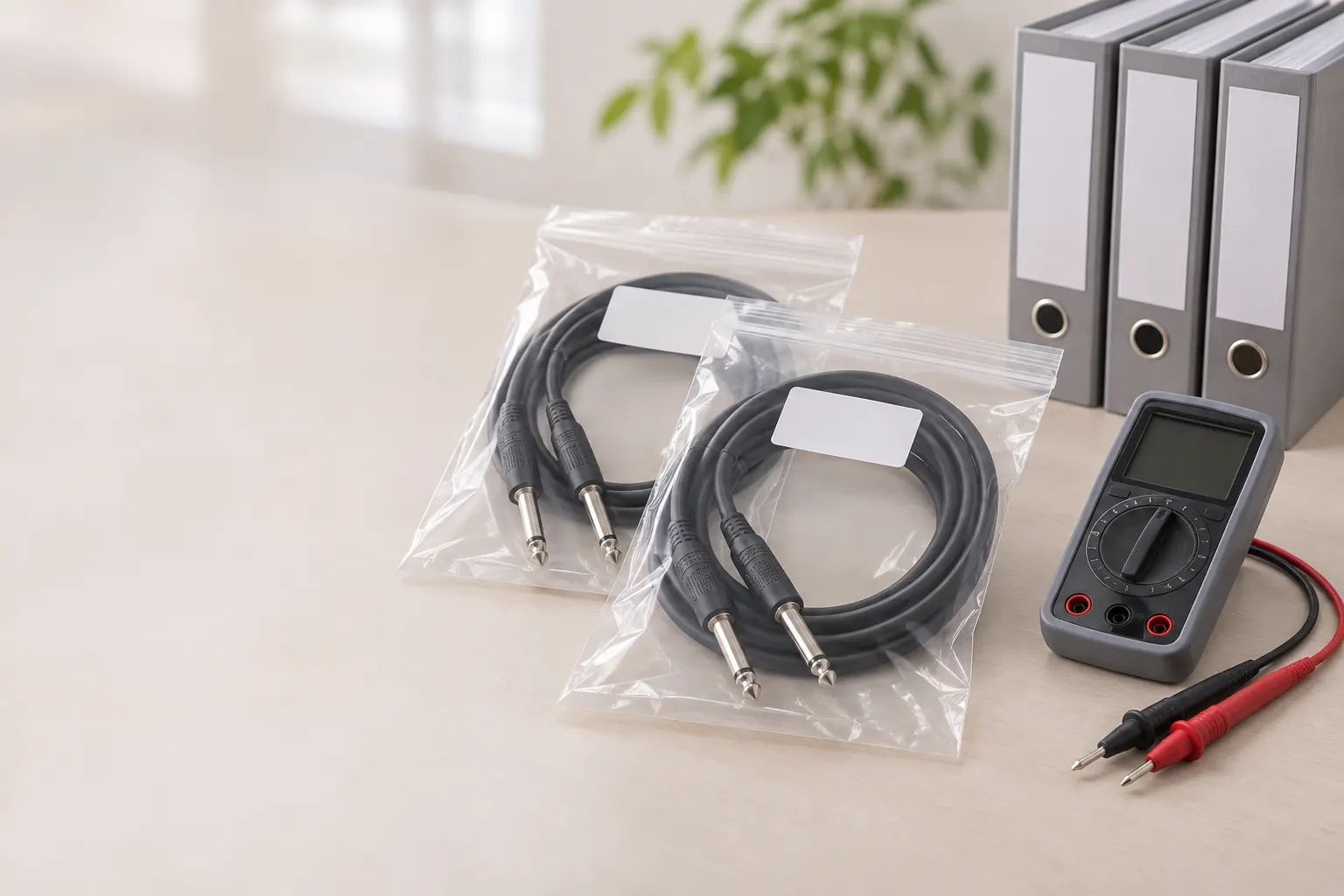
Audio cables sold in the EU, the UK and the US are mainly affected by substance rules (RoHS, REACH and California Proposition 65) and by product safety labeling rules (EU GPSR). We don't publish certificates, because a test report belongs to the brand whose product was tested. For your cables, we write the substance requirements into the specification, confirm them in writing at order, and can arrange third-party testing per project, with reports issued in your brand's name.
The EU RoHS Directive (2011/65/EU, as amended by Delegated Directive (EU) 2015/863) restricts ten substances in electrical and electronic equipment: lead, mercury, cadmium, hexavalent chromium, two groups of brominated flame retardants (PBB and PBDE) and four phthalates (DEHP, BBP, DBP and DIBP). Cables are within its scope. In an audio cable, the parts to watch are solder, plating, brass connector parts and the plasticizers and pigments in PVC jackets.
Your specification states the RoHS requirement, and we confirm it in writing at order. If your market, retailer or marketplace asks for a RoHS test report, we arrange testing of your finished cable at a third-party laboratory, and the report is issued in your brand's name.
REACH (Regulation (EC) No 1907/2006) applies to chemicals in all products sold in the EU, including articles such as cables. Two parts matter most:
An SVHC screening test can be arranged for your cable per project, with the report issued in your brand's name.
Proposition 65 requires businesses with 10 or more employees to give a clear and reasonable warning before exposing people in California to listed chemicals. For cables, the usual questions are lead in brass connector parts and certain phthalates in PVC jackets.
Whether your product needs a warning is your decision, ideally made with a compliance advisor and based on test results for your materials. We can arrange the testing, and we print the warning text you choose on the product or packaging.
The EU General Product Safety Regulation (EU) 2023/988 has applied to consumer products since 13 December 2024. A cable sold to consumers in the EU needs a product identifier, such as a model or batch number, and the manufacturer's name, postal address and electronic contact. When the manufacturer is outside the EU, the details of an economic operator in the EU must also appear. Warnings and safety information must be in a language that consumers in the country of sale can easily understand, as set by that country.
We print the label information you provide on the product, packaging or insert. Haisen is not your EU Responsible Person or importer; your brand or importer remains responsible for compliance in each market.
FCC equipment authorization in the US applies to devices that generate radio-frequency energy, such as products with digital electronics. A passive cable with no electronics generally does not need FCC testing.
CE marking applies when an EU directive that requires it covers the product. RoHS covers cables, so ask your compliance advisor whether and how CE marking applies to your product. CE marking is a declaration made by the manufacturer or brand, not a certificate, so we never describe a passive cable as "CE certified".
We don't share reports made for other brands, and we don't publish certificates on this site.
Related pages
How we specify each order, approve the golden sample and inspect every bulk order before it ships.
Packaging formats, barcodes and the label details we print for your markets, such as GPSR and origin marking.
The checks and AQL levels behind every bulk order, and what the pre-shipment inspection report covers.
No certificates or test reports are published here: a test report is issued for the buyer whose product was tested and is not shared with other buyers.
Last reviewed
Compliance testing such as RoHS or REACH SVHC can be arranged per project for your cables, with reports issued in your brand's name. Tell us your product and target markets.
Cookies on this site
We use strictly necessary cookies to run and secure this website. With your permission, we would also like to use Google Analytics cookies to understand how the site is used. See our Cookie Policy.
We use necessary cookies, and analytics cookies only with your consent. Cookie Policy.
Your browser sent a Global Privacy Control signal, so we have turned analytics cookies off. Only strictly necessary cookies are used.