Key facts
| Fact | Details |
|---|---|
| What is measured | Capacitance between center conductor and shield, per unit length |
| Common units | pF/m; pF/ft (1 pF/m = 0.3048 pF/ft) |
| Published range for guitar cables | About 52 pF/m to nearly 200 pF/m (Elliott Sound Products); around 100 pF/m is a commonly quoted figure (Sound On Sound; Premier Guitar) |
| Total capacitance | Rating × length: 100 pF/m × 6 m = 600 pF |
| Who hears the difference | Players using passive pickups straight into an amp or true-bypass pedals |
| Who barely does | Active pickups, buffered pedal chains, and low-impedance line or balanced signals |
What is instrument cable capacitance?
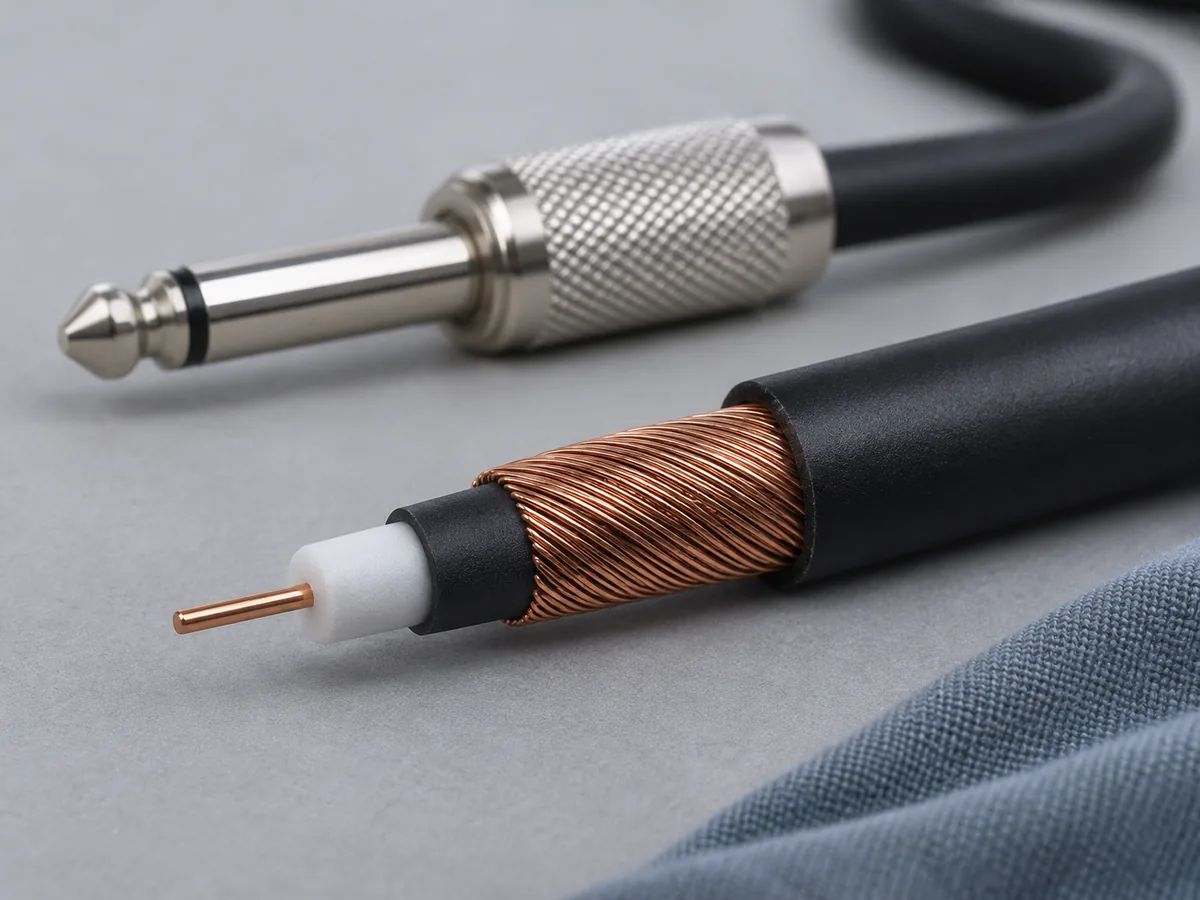
Any two conductors separated by insulation form a capacitor. In a coaxial instrument cable, the center conductor and the surrounding shield are those two conductors, and the insulation between them is the dielectric. The longer the cable, the larger the capacitor.
Manufacturers publish capacitance per unit length so cables can be compared regardless of length. To find the capacitance a guitar actually "sees," multiply the rating by the cable length. Plugs add a small amount more.
Why does capacitance change the sound of a passive guitar?
A passive magnetic pickup is a coil with high inductance, significant resistance, and a small capacitance of its own between the turns of wire. Connected to a cable and an amplifier input, it forms a resonant low-pass circuit. In a simplified model, the pickup's inductance (L) and the total capacitance (C: the pickup's own capacitance plus the cable and anything else connected) set the frequency of a resonant peak:
f = 1 / (2π √(L × C))
Below the peak, the response is fairly flat. Around the peak, there is a lift. Above it, the output falls away. Adding capacitance moves the peak lower in frequency. The amp's input resistance and the guitar's volume and tone controls damp the peak, which also reduces its height. Elliott Sound Products notes that external cable capacitance "will reduce the frequency and amplitude of the peak." Sound On Sound describes the same mechanism: low-capacitance cable lets the circuit resonate higher, and high-capacitance cable pushes the resonance down.
Because the frequency depends on the square root of capacitance, doubling the total capacitance divides the peak frequency by √2 (about 1.41). That is a drop of roughly 29%.
How much capacitance does a typical cable add?
Published guitar cable ratings fall roughly between 50 and 200 pF/m. Elliott Sound Products reports a range of 52 pF/m to nearly 200 pF/m and uses around 125 pF/m in its discussion. Sound On Sound gives roughly 100 pF/m (about 30 pF/ft). Premier Guitar puts many modern cables near 100 pF/m and some ultra-low-capacitance designs at 60 pF/m or less, and notes that older cables, especially coiled ones, reached 400 pF/m or more.
The table below shows the arithmetic. These are not measurements of any specific product.
| Rating | pF/ft equivalent | 3 m (about 10 ft) | 6 m (about 20 ft) | 9 m (about 30 ft) |
|---|---|---|---|---|
| 60 pF/m | 18.3 pF/ft | 180 pF | 360 pF | 540 pF |
| 100 pF/m | 30.5 pF/ft | 300 pF | 600 pF | 900 pF |
| 150 pF/m | 45.7 pF/ft | 450 pF | 900 pF | 1,350 pF |
| 200 pF/m | 61.0 pF/ft | 600 pF | 1,200 pF | 1,800 pF |
Two points stand out. First, length matters as much as the rating: a 6 m cable at 100 pF/m equals a 3 m cable at 200 pF/m. Second, with true-bypass pedals, every cable between the guitar and the first buffered stage adds to the total, including patch cables on the pedalboard. Each bypassed pedal's jacks and internal wiring add a small amount more.
What does that shift look like in numbers?
The worked example below uses the formula above with an assumed pickup inductance of 4 H, chosen only to make the arithmetic concrete. Passive pickups vary widely in inductance. The table counts cable capacitance only; adding the pickup's own winding capacitance would lower every frequency further, and the amp input and the guitar's controls change the height of the peak. Treat the results as an illustration of the trend, not as a prediction for a particular guitar.
(assumed L = 4 H; cable capacitance only; pickup self-capacitance, resistance and other loading ignored)
| Total capacitance | Example from Table 1 | Approximate resonant frequency |
|---|---|---|
| 300 pF | 3 m at 100 pF/m | 4.6 kHz |
| 600 pF | 6 m at 100 pF/m | 3.2 kHz |
| 900 pF | 9 m at 100 pF/m | 2.7 kHz |
| 1,350 pF | 9 m at 150 pF/m | 2.2 kHz |
| 1,800 pF | 9 m at 200 pF/m | 1.9 kHz |
For comparison, the pickup model in Elliott Sound Products' example resonates at around 2.7 kHz. In practice, the peak for a passive guitar and cable usually sits in the low-kilohertz range, where shifts can be heard as changes in brightness and presence.
Does lower capacitance always mean a better cable?
No. Lower capacitance keeps more high-frequency content over a given length, which many players want on long cable runs. It is not a quality score on its own. Premier Guitar notes that some guitars can sound too trebly with modern cables, and that cable choice is one way to tame a shrill-sounding guitar.
For a buyer or brand, capacitance is one specification among several that decide whether a cable works in daily use:
- Handling noise. A conductive layer over the insulation reduces the crackle when a cable is moved or stepped on.
- Shielding. Shield type and coverage affect hum and radio-frequency pickup.
- Flexibility and memory. These decide whether a cable lies flat on stage and coils neatly.
- Plug and strain-relief construction. Most cable failures happen at the plug, not in the cable itself.
- Outer diameter. It must fit the plug's cable entry and match customer expectations.
What determines a cable's capacitance?
Capacitance per meter is set mainly by the insulation material and the cable's geometry:
| Factor | Effect on capacitance |
|---|---|
| Insulation material (dielectric constant) | Lower dielectric constant gives lower capacitance. Foamed polyethylene (PE) is lower than solid PE, and PE is generally lower than PVC. |
| Insulation thickness | Thicker insulation puts the shield further from the conductor and lowers capacitance, but increases outer diameter. |
| Conductor diameter | For the same insulation thickness, a larger conductor raises capacitance. |
| Construction consistency | Uneven insulation or a loose shield changes capacitance along the cable and between batches. |
| Length | Total capacitance scales directly with length. |
The conductive layer that reduces handling noise is there to control triboelectric noise, not to set capacitance. Judge any cable by the measured capacitance of the finished construction.
How should a capacitance specification be written and checked?
A capacitance figure is only useful if you know how it was measured. When you compare cables or write your own specification, ask for these details:
- Value and unit, for example "100 pF/m." On North American pages, the pF/ft equivalent can be added.
- What was measured. For an instrument cable, this is center conductor to shield.
- Instrument and test frequency. Typically an LCR meter at 1 kHz, measuring at one end with the far end left open (not connected).
- Sample. A known length of finished cable (state whether plugs are included), with the result divided by length. Use a sample long enough that the meter's test-lead capacitance is small by comparison, and state the length used.
- Source. Is it a measured value on production cable, a value from the cable manufacturer's datasheet, or a design target?
- Tolerance or range across batches, if the figure appears in your marketing.
How we handle this on haisenaudio.com: a capacitance value appears on a product page only when it comes from a supplier datasheet or a measurement, together with the test conditions. Until then, the field stays hidden. We follow the same rule for "low-capacitance" wording. If your brand plans to market capacitance, build the measurement into your sample approval so that the published number matches what ships.
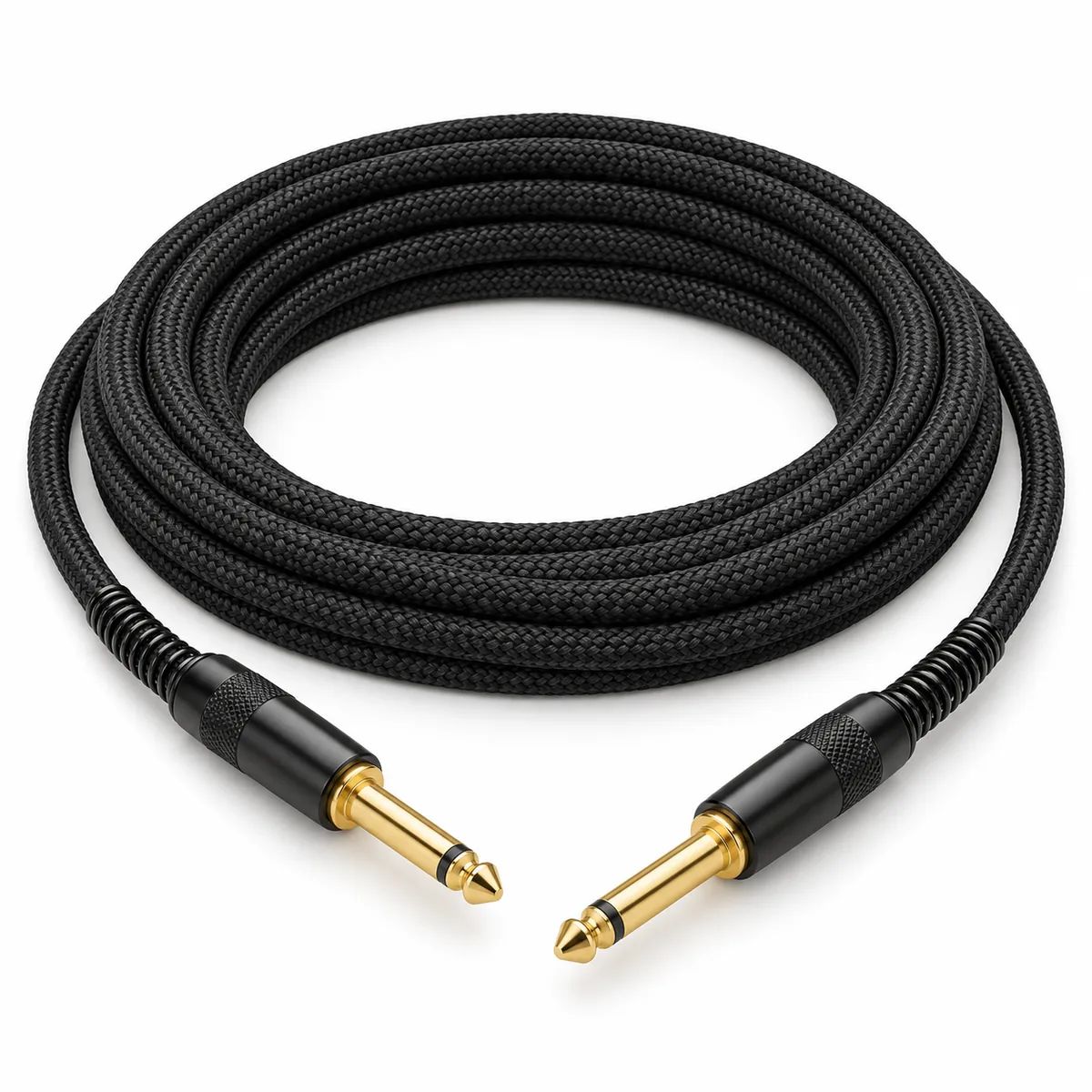
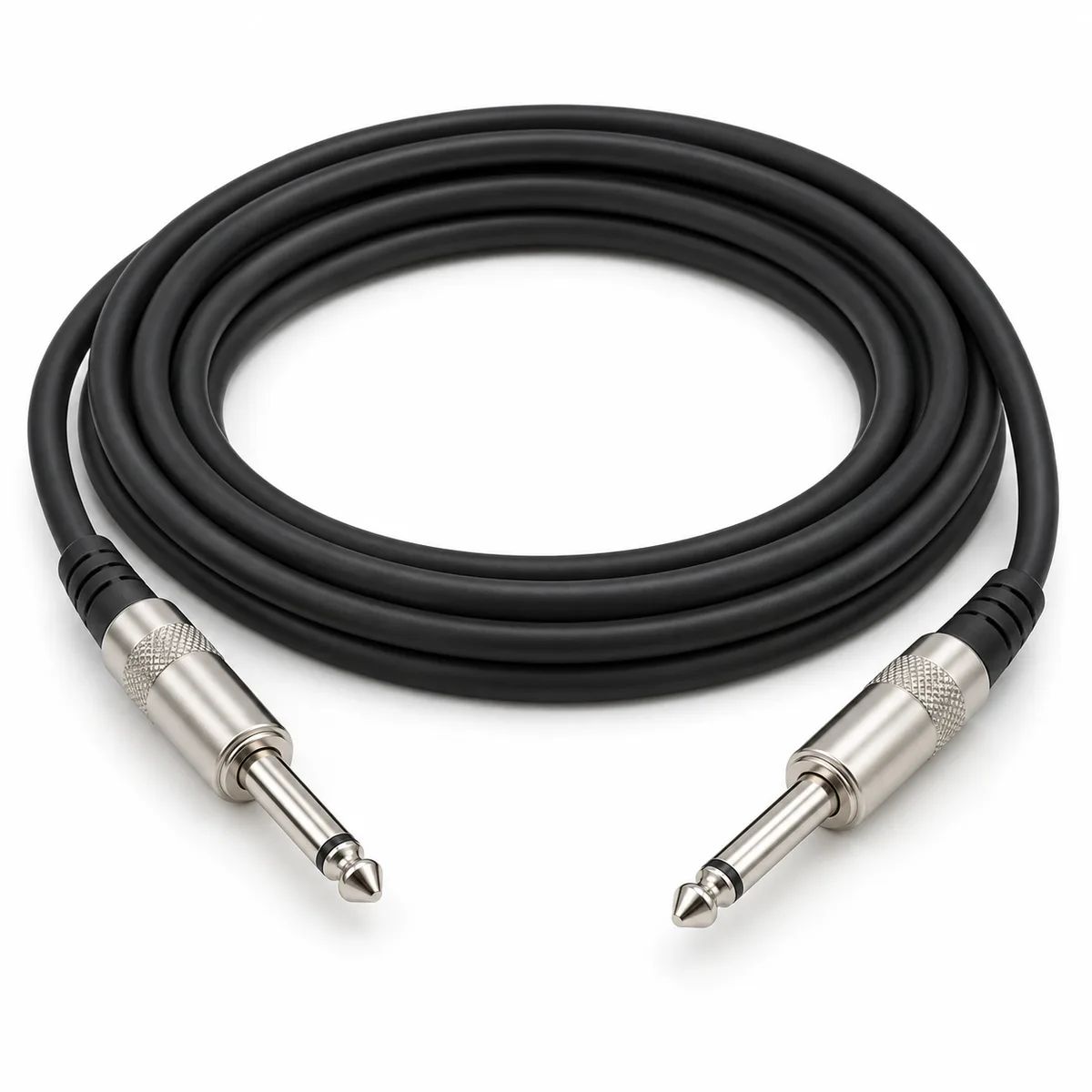
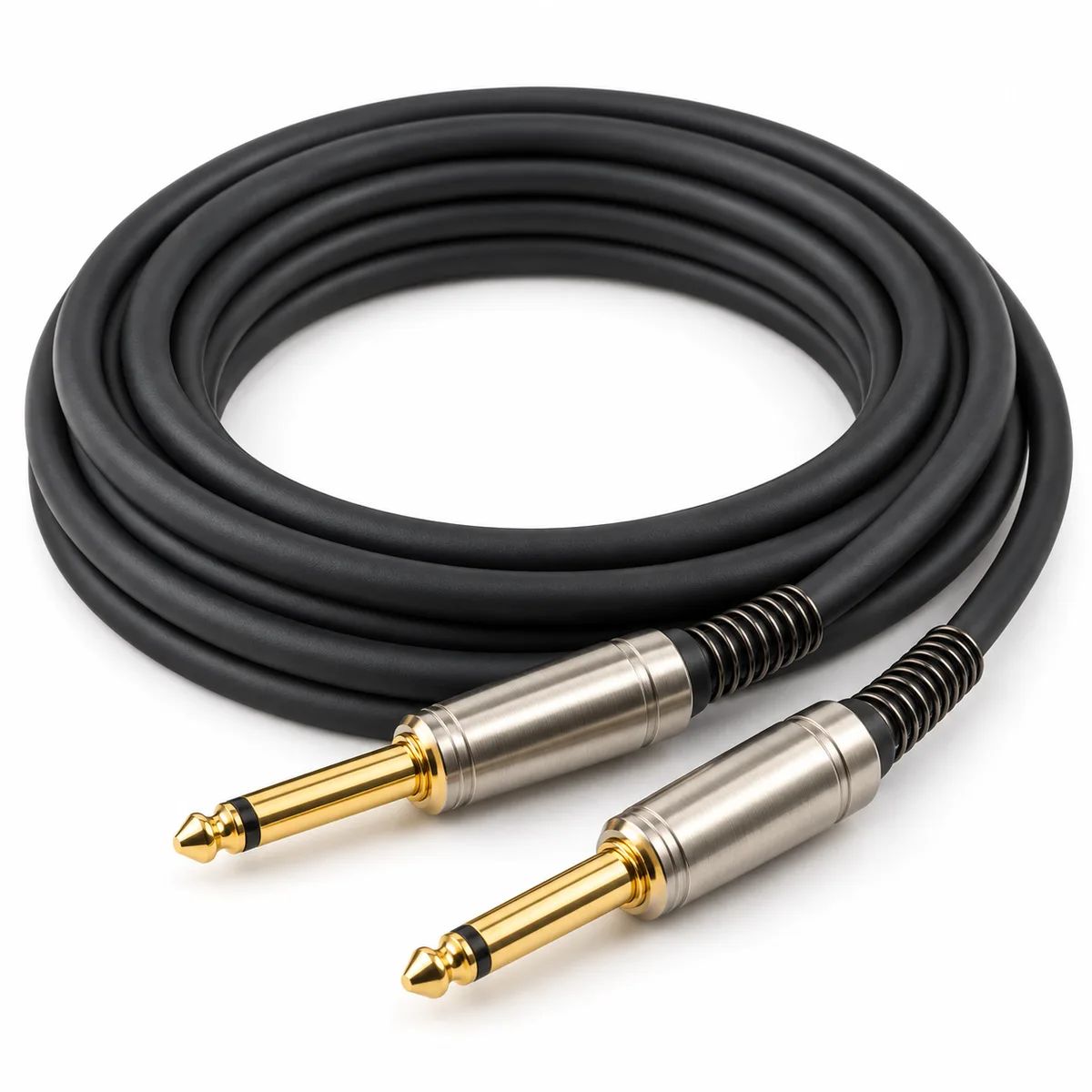
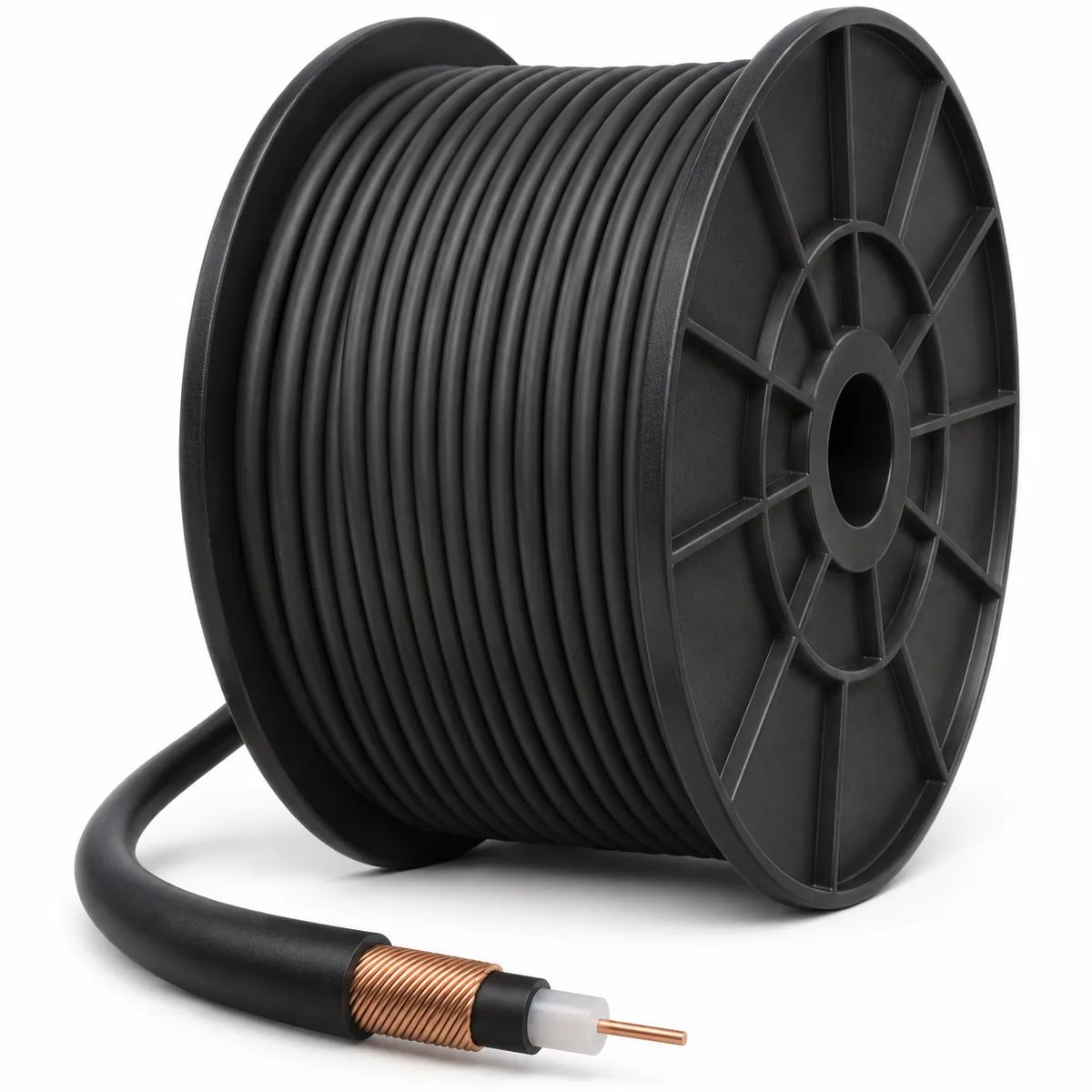
Instrument cable options are listed in our instrument cables and braided instrument cables categories, including the braided 1/4" (6.35 mm) TS instrument cable, the standard 1/4" TS instrument cable and the heavy-duty instrument cable with conductive layer. Cable builders can also buy bulk instrument cable by the reel.
Specifying capacitance for your own cable line? Tell us the target length, jacket and plug style, and whether you plan to publish a capacitance figure. We will confirm what can be specified and measured before sampling. Request an OEM quote
When does cable capacitance not matter much?
Capacitance matters most with a passive, high-impedance source. It matters much less when the source has a low output impedance:
- Active pickups. Sound On Sound notes that cable choice "will make very little difference" because of their low output impedance.
- Buffered pedals or a buffer at the start of the chain. After a buffer, cable capacitance has far less effect on treble.
- Line-level and balanced connections. Keyboards, interfaces, mixers and professional microphones are low-impedance sources. Over normal lengths, cable capacitance there has little audible effect on frequency response.
Frequently asked questions
What is a good capacitance for a guitar cable?
There is no single correct value. Published guitar cables range from about 52 to nearly 200 pF/m, and around 100 pF/m is a commonly quoted figure. Lower values keep more treble over long runs. Choose based on cable length, pickups and the sound the player wants.
Does a longer guitar cable change the tone?
Yes, with passive pickups. Total capacitance grows with length, so a longer cable lowers the pickup's resonant peak and reduces treble. A 6 m cable has twice the capacitance of a 3 m cable of the same type.
How do I convert pF per meter to pF per foot?
Multiply pF/m by 0.3048. For example, 100 pF/m is about 30.5 pF/ft. To convert pF/ft to pF/m, divide by 0.3048: 30 pF/ft is about 98 pF/m.
Do active pickups need low-capacitance cable?
Usually not. Active pickups and buffered pedals have a low output impedance, so normal cable capacitance has little effect on their frequency response. Capacitance mainly matters with passive pickups connected directly to an amp or through true-bypass pedals.
Is capacitance printed on every cable's specification?
No. Many cables publish no capacitance figure. When one is given, check that it states what was measured (conductor to shield), the test frequency and whether it is a measured or design value. Without those, figures cannot be compared fairly.