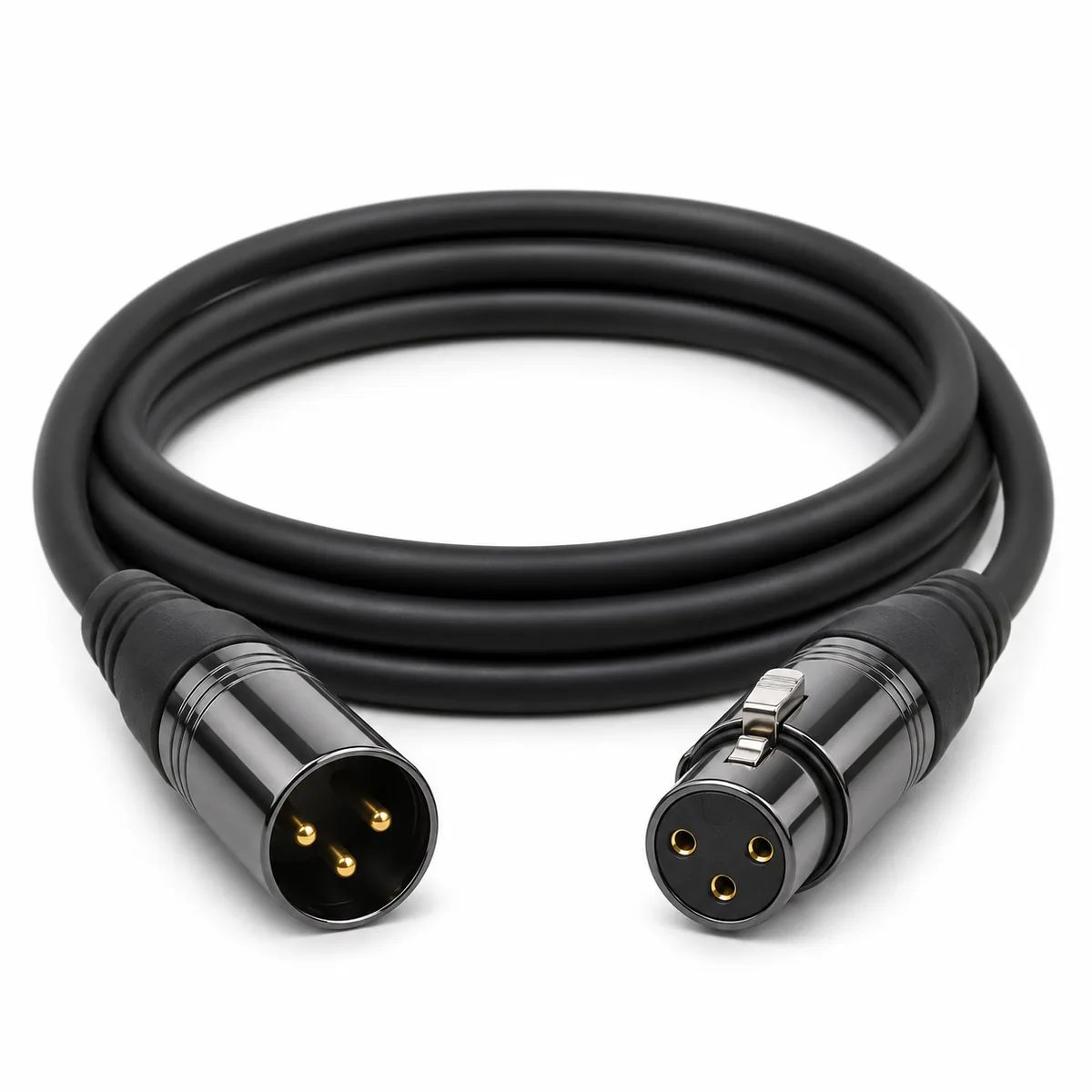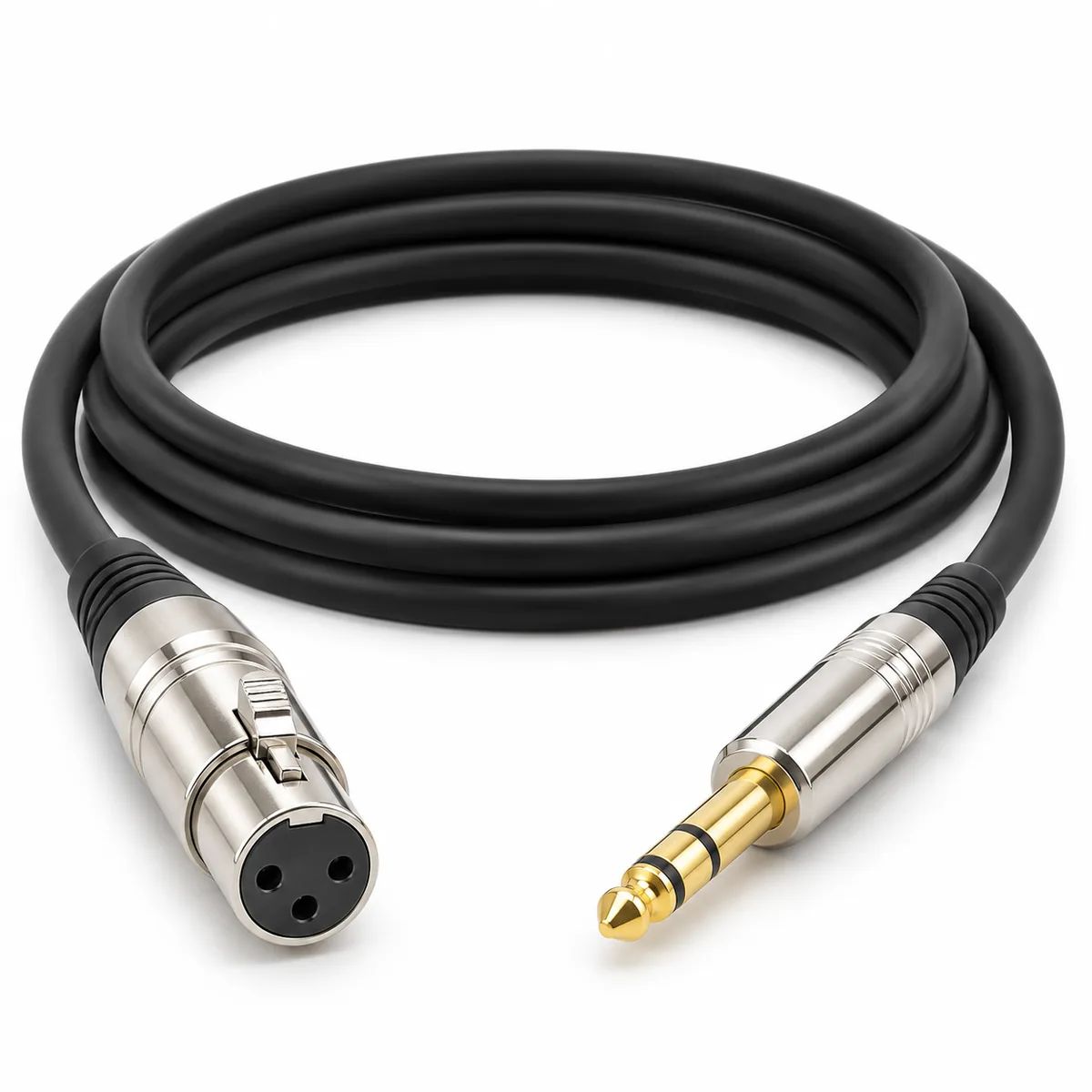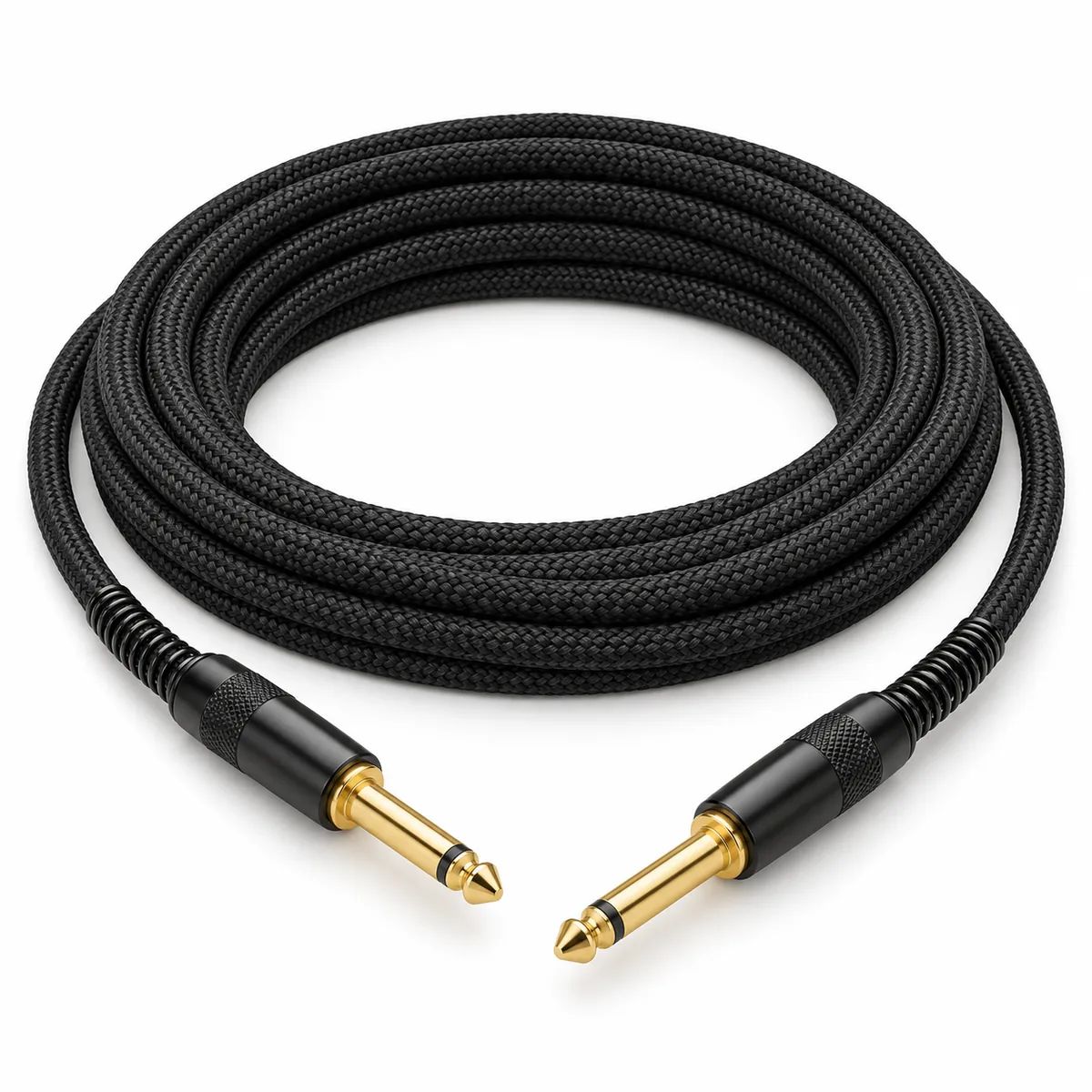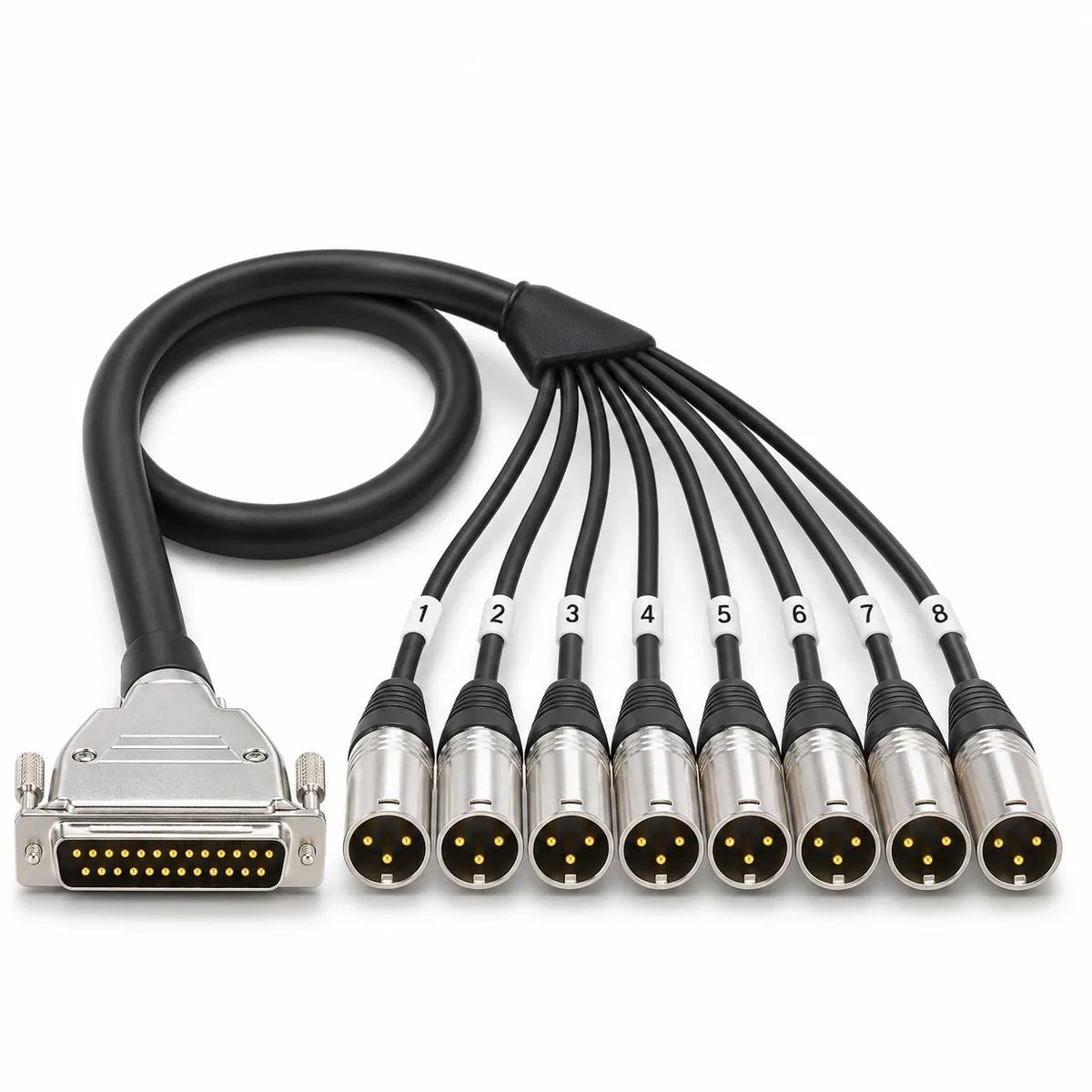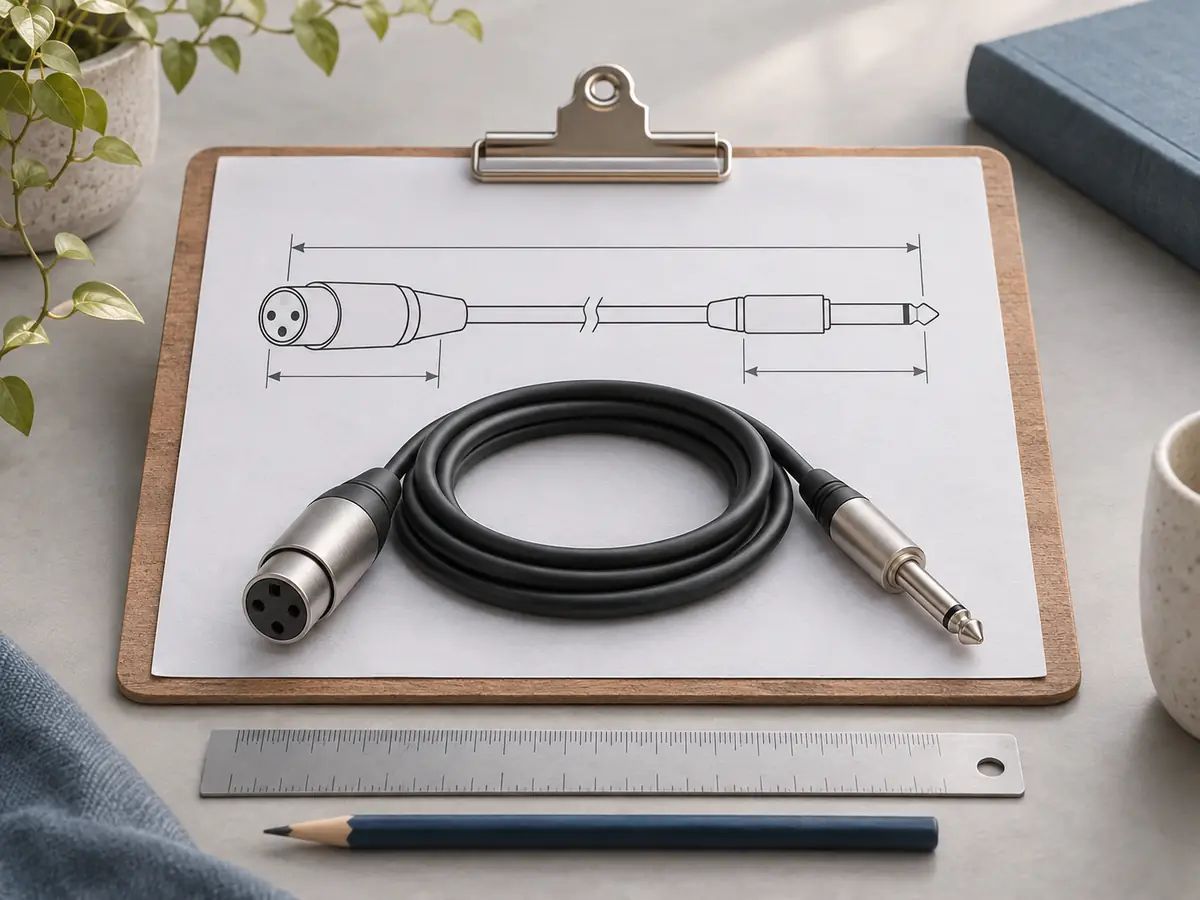
Download: Custom Cable Specification Template (editable XLSX). You'll also find it on our Downloads page. The full field list is in Appendix A below.
Key facts
| Fact | Details |
|---|---|
| Purpose | One written reference for quoting, sampling, production and inspection |
| Core sections | Construction, connectors, wiring table, length and tolerance, tests, branding, packaging, compliance documents, acceptance |
| Most common gaps | Length measurement point, pin-numbering view, color references, "same as sample" without a sample ID |
| Requirement levels | Mark each line Must, Preferred or Open to suggestion |
| Version control | Revision number and date on every page; samples and production refer to one revision |
| Acceptance | An approved golden sample plus written inspection criteria |
Why do cable specifications get misread?
Most misreadings come from words that feel precise to the buyer but leave a choice to the supplier. "10 ft cable," "gold plugs," "black" and "good shielding" each have several valid interpretations. The supplier picks the one that fits their standard parts, and the difference shows up only at the sample stage, or after production.
Three habits prevent most problems:
- Write numbers with units and tolerances, not adjectives.
- Use tables for wiring, not sentences.
- Point to references, such as a color code, a drawing number or a sample ID, instead of describing from memory.
What should a custom cable spec sheet include?
A complete spec sheet covers ten areas. You do not need every field for a simple cable, but you should decide consciously which ones to leave open.
| Section | What to define | Typical mistake |
|---|---|---|
| 1. Identification | Your part number, product name, revision, date, owner | No revision number, so two versions circulate |
| 2. Cable construction | Conductor, gauge, insulation, shield, jacket, outer diameter | "Good shielding" with no type or coverage |
| 3. Connectors | Type, gender, angle, housing, contact plating, strain relief | "Gold plug" without stating whether the contacts or the housing finish are gold |
| 4. Wiring | Pin-to-pin wiring table for each end | Describing the wiring in a sentence |
| 5. Length | Nominal length, tolerance, measurement points | No measurement point, so a 5 cm difference is "in spec" for both sides |
| 6. Tests | Electrical and mechanical checks with method and pass criteria | "100% tested" without saying what is tested |
| 7. Branding | Logo method, position, size, artwork file | Logo file in a low-resolution image |
| 8. Packaging and labeling | Unit pack, insert card, barcode, inner and outer carton marks | Barcode left for the supplier to create |
| 9. Compliance documents | Test reports needed for your market | Asking for "certificates" without naming the regulation |
| 10. Acceptance | Golden sample, inspection plan, defect definitions | No agreed sample to judge production against |
Cable construction
Name each layer from the center outward. For an instrument cable, that could be: conductor material and gauge (for example 20 AWG, with strand count), insulation material, conductive layer (yes or no), shield type and coverage requirement, jacket material, color and outer diameter with tolerance.
State material honestly and ask the supplier to do the same. If you plan to market a material claim such as OFC, silver-plated copper or a purity grade, have the material confirmed in writing on your order, and commission an independent lab test at your cost if you need proof. If you plan to publish capacitance, require a measured value with its test conditions. See Instrument Cable Capacitance Explained for what to ask for.
Connectors
For each end, state:
- connector type and size, for example 1/4" (6.35 mm) TS, 3-pin XLR or 3.5 mm TRS
- gender, plus straight or right-angle
- housing material and finish, plus space for a laser-engraved logo if needed
- contact plating, stated separately from the housing finish
- strain relief type
- whether genuine branded connectors are required. If they are, ask for proof of purchase. If they are not, describe the part generically.
Wiring table
Write a table with one row per conductor. Here is a balanced XLR female to 1/4" TRS cable as an example:
| End A: XLR female | End B: 1/4" TRS plug | Conductor | Signal |
|---|---|---|---|
| Pin 2 | Tip | Conductor 1 (state color) | Hot (+) |
| Pin 3 | Ring | Conductor 2 (state color) | Cold (−) |
| Pin 1 | Sleeve | Shield | Shield / ground |
| Connector shell | — | Not connected / connected to pin 1 (choose one) | — |
The XLR pin numbers follow AES14 (pin 1 shield, pin 2 hot, pin 3 cold). Two details cause most wiring disputes:
- Pin-numbering view. State whether a drawing shows the connector from the mating face or from the solder side. Pin positions are mirrored between the two views.
- Shell connection. Whether the XLR shell connects to pin 1 is a design choice. Write it down.
Some fixed installations connect the shield at one end only to deal with a specific hum problem. If you need that, state which end. Do not use it on microphone cables: phantom power returns through pin 1, so the shield must be connected at both ends.
For multi-channel assemblies such as a DB25 to XLR breakout cable, attach the full channel table and name the pinout standard used.
Length and tolerance
Give the nominal length, the tolerance and the measurement points. One workable format:
- Nominal length: 3.05 m (10 ft)
- Measured: from plug tip to plug tip, cable laid straight
- Tolerance: for example −0 / +2%, so the cable is never shorter than labeled
If you sell in feet, make sure the cable is at least as long as the label: 10 ft is 3.05 m, not 3 m. For short patch cables, say whether length is measured between housings or tip to tip. On a 15 cm (6 in) cable, a few centimeters is a large share of the length.
Tests and pass criteria
List each check with what is measured and what passes. Typical checks for passive audio cables:
| Check | What it confirms | How to write it |
|---|---|---|
| Continuity | Every conductor is connected end to end | "Continuity on all conductors per wiring table: pass/fail" |
| Short circuit | No conductor touches another or the shield | "No short between any two conductors" |
| Wiring/polarity | Pins match the wiring table | "Pin-to-pin check against wiring table rev. X" |
| Intermittent contact | No dropout when the cable is flexed at each strain relief | "Flex at each end while monitoring continuity" |
| Pull or flex test (if required) | Mechanical durability | State force, cycles, angle and method, or ask the supplier to propose a method |
| Capacitance (if marketed) | Published electrical value is accurate | "Conductor to shield, 1 kHz, on [length] sample" |
Say which checks apply to every unit and which apply to a sample from each batch. For an established workmanship reference, IPC/WHMA-A-620 sets out acceptance criteria for cable and wire harness assemblies in three product classes (Class 1, 2 and 3, with increasingly strict criteria). If you reference it, name the class you require and confirm in writing that the supplier inspects to that class.
Branding, packaging and labeling
Attach vector artwork (SVG, AI or PDF) for every logo, with position and size on the drawing. For colors, give a reference such as a Pantone code and ask for a color sample. Define the unit pack (tie, bag, insert card or box), the barcode type and number, and the carton marks. Use barcodes registered to your company through GS1; do not ask a supplier to create barcode numbers.
Compliance documents
Name the regulations for your sales markets and the documents you expect. For example, EU RoHS and REACH (SVHC) test reports, or a California Proposition 65 assessment for US sales. Ask for reports that name the model, the testing laboratory, the report number and the issue date. If you sell the cable under your own brand, you are usually treated as a party responsible for compliance in your market, and a supplier's test report does not transfer that responsibility. Keep these documents on file, and confirm your obligations with a compliance advisor.
Acceptance: golden sample and inspection
Agree on a golden sample, a signed and labeled sample that production must match, and record its revision. Then define how production will be checked: what counts as a critical, major and minor defect, and which sampling plan applies. Many buyers use AQL sampling under ISO 2859-1 and state the inspection level and AQL values in the spec.
Vague vs precise: how should you rewrite common phrases?
The precise versions below are format examples. The values, codes and file names are placeholders, not recommendations.
| Vague | Precise |
|---|---|
| 10 ft cable | 3.05 m (10 ft) nominal, tip to tip, −0 / +2% |
| Gold plugs | Contacts: gold-plated brass. Housing: zinc alloy, black finish (state plating or paint) |
| Black | Jacket: black, matte, color reference [code]; match approved color sample #CS-01 |
| Good shielding | Braided copper shield, coverage ≥ [value]% (supplier to provide calculation) |
| Low noise | Conductive PVC layer under the shield to reduce handling noise |
| Same as sample | Match golden sample GS-0042, rev. B, approved [date] |
| Standard XLR wiring | Pin 1 shield, pin 2 hot, pin 3 cold; shell not connected to pin 1 |
| Logo on plug | Laser engraving on End A housing, 12 × 4 mm, centered, artwork file logo-v2.svg |
| Tested | 100%: continuity, short, wiring per table. Per batch: [checks and sample size] |
How do you mark what is fixed and what is flexible?
Mark every line with one of three levels:
- Must: a change needs your written approval.
- Preferred: the supplier may propose an alternative, with the reason and the cost or lead-time effect.
- Open to suggestion: you want the supplier's recommendation.
This keeps quotes comparable. It also shows the supplier where a standard part can save cost and where it cannot.
How should you use the spec with a supplier?
- Fill in the template and attach drawings, photos of reference parts, and artwork.
- Send it with your quantities per SKU and your target delivery date.
- Ask for a written list of questions and deviations before any sample is made.
- Agree on a revised version and give it a new revision number.
- Approve a sample against that revision and keep it as the golden sample.
- Reference the revision and the golden sample in the purchase order.
When you send a spec to Haisen Audio, we review it with our manufacturing partners, list any questions or deviations, and confirm the agreed specification in writing before production. We reply within 1 business day of receiving your spec.
Have a spec, a drawing, or just a sample photo? Send it as it is, and we will help turn it into a complete specification. Request an OEM quote. For multi-line project orders or installation BOMs, use the project RFQ form.
Frequently asked questions
What is a cable spec sheet?
A cable spec sheet is a document that defines a cable completely: construction, connectors, wiring, length and tolerance, tests, branding, packaging and acceptance criteria. Suppliers use it to quote, make samples and produce, and buyers use it to check what they receive.
How detailed does a spec need to be for a first order?
Detailed enough that two suppliers would quote the same cable. At a minimum, define connectors, the wiring table, length with measurement points, cable type, logo and packaging. Leave other items marked "Open to suggestion" rather than blank.
Should I specify cable capacitance?
Only if it matters for the use or you plan to publish it. If you do, state the value, what is measured (conductor to shield), the test frequency, and the sample length. Ask for a measured value, not a design target.
Can I use a competitor's cable as the specification?
You can use it as a reference for fit and finish, but write your own specification. Describe parts generically unless you are buying genuine branded components, and do not use other brands' names or "-style" descriptions in your product listings.
What is a golden sample?
A golden sample is an approved, labeled sample that production must match. It is linked to a specific revision of your spec and is kept by both buyer and supplier as the reference for inspection and any dispute.
Appendix A: Custom Cable Specification Template field list
The fields below match the downloadable Custom Cable Specification Template (XLSX). Each field carries a requirement level: Must / Preferred / Open to suggestion. "Req." below shows whether the template treats the field as required for a quote (●) or optional (○).
A1. Document and project
| Field | What to enter | Example | Req. |
|---|---|---|---|
| Company / brand | Buyer company and brand name | — | ● |
| Contact name and email | Person who approves the spec | — | ● |
| Buyer part number | Your internal SKU or part number | AC-XLR-3M-BK | ○ |
| Product name | Working name of the cable | Balanced XLR cable, 3 m | ● |
| Spec revision and date | Revision letter/number and ISO date | Rev. B, 2026-11-01 | ● |
| Revision notes | What changed from the previous revision | Jacket color changed | ○ |
| Target markets | Countries or regions of sale | US, EU | ● |
| End use | How the cable will be used | Stage microphone cable | ● |
A2. Quantities and timing
| Field | What to enter | Example | Req. |
|---|---|---|---|
| Quantity per SKU (first order) | Pieces per length/color variant | [quantity] per variant | ● |
| Forecast (12 months) | Estimated repeat volume | — | ○ |
| Sample quantity | Pieces needed for approval | 2 per variant | ○ |
| Target delivery date | Date at destination | 2027-03-01 | ● |
| Delivery terms and destination | Incoterms® 2020 rule plus a precise named place: full delivery address for DAP / DDP, port or handover point for FOB / FCA | DAP [warehouse address], Los Angeles, Incoterms® 2020 | ● |
| Import into destination | Who acts as importer and handles customs clearance (buyer, buyer's broker, or seller under DDP) | Buyer's customs broker | ○ |
A3. Cable construction
| Field | What to enter | Example | Req. |
|---|---|---|---|
| Cable type | Single-conductor shielded, twisted pair, star-quad, multi-pair, braided core | Twisted pair + shield | ● |
| Conductor material | As confirmed in writing on the order | OFC | ● |
| Conductor size | AWG or mm², plus strand count × strand diameter | 24 AWG, 7 × 0.2 mm | ● |
| Insulation material | — | PE | ○ |
| Conductive layer | Yes / no; conductive PVC or carbon layer | Yes, conductive PVC | ○ |
| Shield type | Braided / spiral (serve) / foil + drain | Braided copper | ● |
| Shield coverage | Minimum %, with calculation or measurement | ≥ [value]% | ○ |
| Jacket material and finish | PVC, TPE, textile braid, etc. | PVC, matte | ● |
| Jacket color and reference | Color name plus reference code or sample ID | Black, [code] | ● |
| Outer diameter and tolerance | mm | 6.0 mm ±0.2 | ● |
| Jacket print | Text, color and repeat interval, or "none" | None | ○ |
| Capacitance (if required) | Value, what is measured, frequency, sample length | [value] pF/m, conductor to shield, 1 kHz | ○ |
| Material verification needed | Written confirmation on the order; independent lab test (buyer's cost) for OFC, SPC, purity or other claims | Lab test for OFC claim | ○ |
A4. Connectors (one block per end: End A / End B)
| Field | What to enter | Example | Req. |
|---|---|---|---|
| Connector type and size | — | 3-pin XLR | ● |
| Gender | Male / female / plug / jack | Female | ● |
| Orientation | Straight / right-angle / pancake | Straight | ● |
| Housing material and finish | — | Zinc alloy, black | ● |
| Contact plating | Gold / silver / nickel, stated separately from the housing | Silver-plated contacts | ● |
| Strain relief | Boot, spring, clamp | Rubber boot + clamp | ○ |
| Genuine branded part required? | Yes (proof of purchase) / No (generic) | No | ● |
| Color ring or ID marking | Color, position | Red ring | ○ |
| Logo on housing | Method, position, size, artwork file | Laser, 12 × 4 mm, logo-v2.svg | ○ |
A5. Wiring
| Field | What to enter | Example | Req. |
|---|---|---|---|
| Wiring table | One row per conductor: End A pin → End B pin, conductor color, signal | See article example | ● |
| Drawing view | Mating face or solder side | Mating face | ● |
| Shell / chassis connection | Connected to shield/pin 1, or not | Not connected | ● |
| Shield termination | Both ends / one end only (which); microphone cables: both ends | Both ends | ● |
| Pinout standard (multi-channel) | Name of the standard used | — | ○ |
| Drawing file | PDF or DWG with drawing number | DRW-001 rev. B | ○ |
A6. Length
| Field | What to enter | Example | Req. |
|---|---|---|---|
| Nominal length | Metric, plus imperial if sold in feet | 3.05 m (10 ft) | ● |
| Measurement points | Tip to tip / housing to housing | Tip to tip | ● |
| Tolerance | ± value or −0 / + value | −0 / +2% | ● |
| Breakout or fan-out lengths | For multi-leg assemblies | 0.5 m each leg | ○ |
A7. Tests and inspection
| Field | What to enter | Example | Req. |
|---|---|---|---|
| 100% electrical checks | Continuity, short, wiring | Continuity, short, wiring | ● |
| Batch checks | Check, sample size, pass criteria | [checks / sample size] | ○ |
| Mechanical tests | Pull / flex: method, force, cycles | Supplier to propose | ○ |
| Workmanship reference | e.g., IPC/WHMA-A-620 and class (1, 2 or 3) | — | ○ |
| Defect classification | Critical / major / minor definitions | — | ○ |
| Sampling plan | e.g., ISO 2859-1, inspection level, AQL values | — | ○ |
| Third-party inspection | Required? Company? | — | ○ |
| Test records required | Which records the buyer receives | — | ○ |
A8. Branding, packaging and labeling
| Field | What to enter | Example | Req. |
|---|---|---|---|
| Cable tie | Type, color, logo | Hook-and-loop tie, printed logo | ○ |
| Unit packaging | Bag, insert card, box, size | PE bag + insert card | ● |
| Artwork files | Vector files and print colors | insert-card-v3.pdf | ○ |
| Barcode | Type (UPC-A / EAN-13) and number, supplied by buyer | UPC-A [number] | ○ |
| Labels and warnings | Language, regulatory text supplied by buyer | — | ○ |
| Inner pack / carton quantity | Units per inner and per carton | 10 / 100 | ○ |
| Carton marks | Text and label template | — | ○ |
| Marketplace prep | Marketplace labeling requirements, if any | — | ○ |
A9. Compliance documents
| Field | What to enter | Example | Req. |
|---|---|---|---|
| Regulations for target markets | Name each | EU RoHS, REACH SVHC; California Prop 65 | ● |
| Reports required | Per model; lab, report number, date | RoHS test report | ● |
| Country of origin marking | Text and position, as required by your destination market | Made in China | ○ |
| Responsible party details | Name and address of the party responsible for the product in your market, supplied by buyer for labeling | — | ○ |
A10. Acceptance and sign-off
| Field | What to enter | Example | Req. |
|---|---|---|---|
| Requirement levels | Each line marked Must / Preferred / Open to suggestion | — | ● |
| Golden sample ID | ID and linked spec revision | GS-0042, rev. B | ○ |
| Approved by (buyer) | Name, date | — | ● |
| Confirmed by (supplier) | Name, date | — | ● |