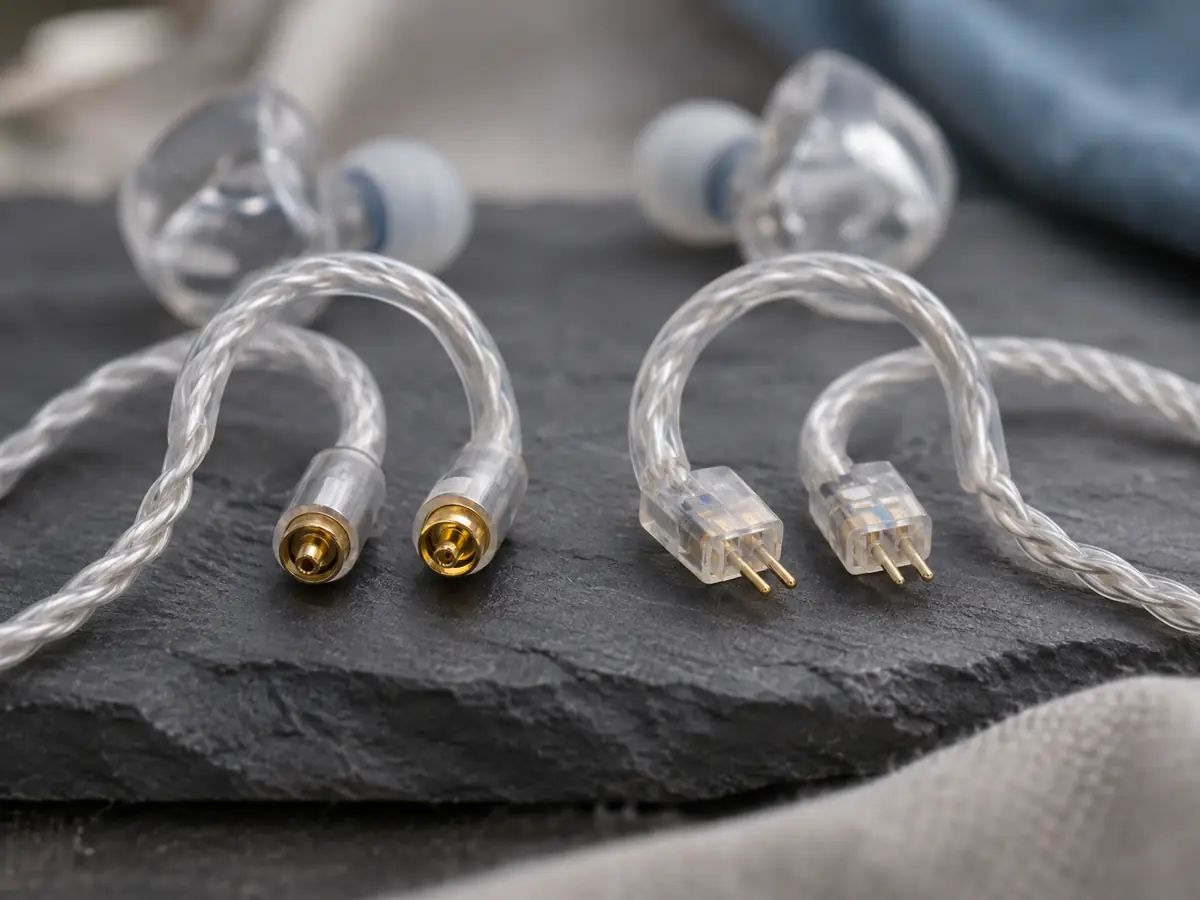
Key facts
| Fact | Details |
|---|---|
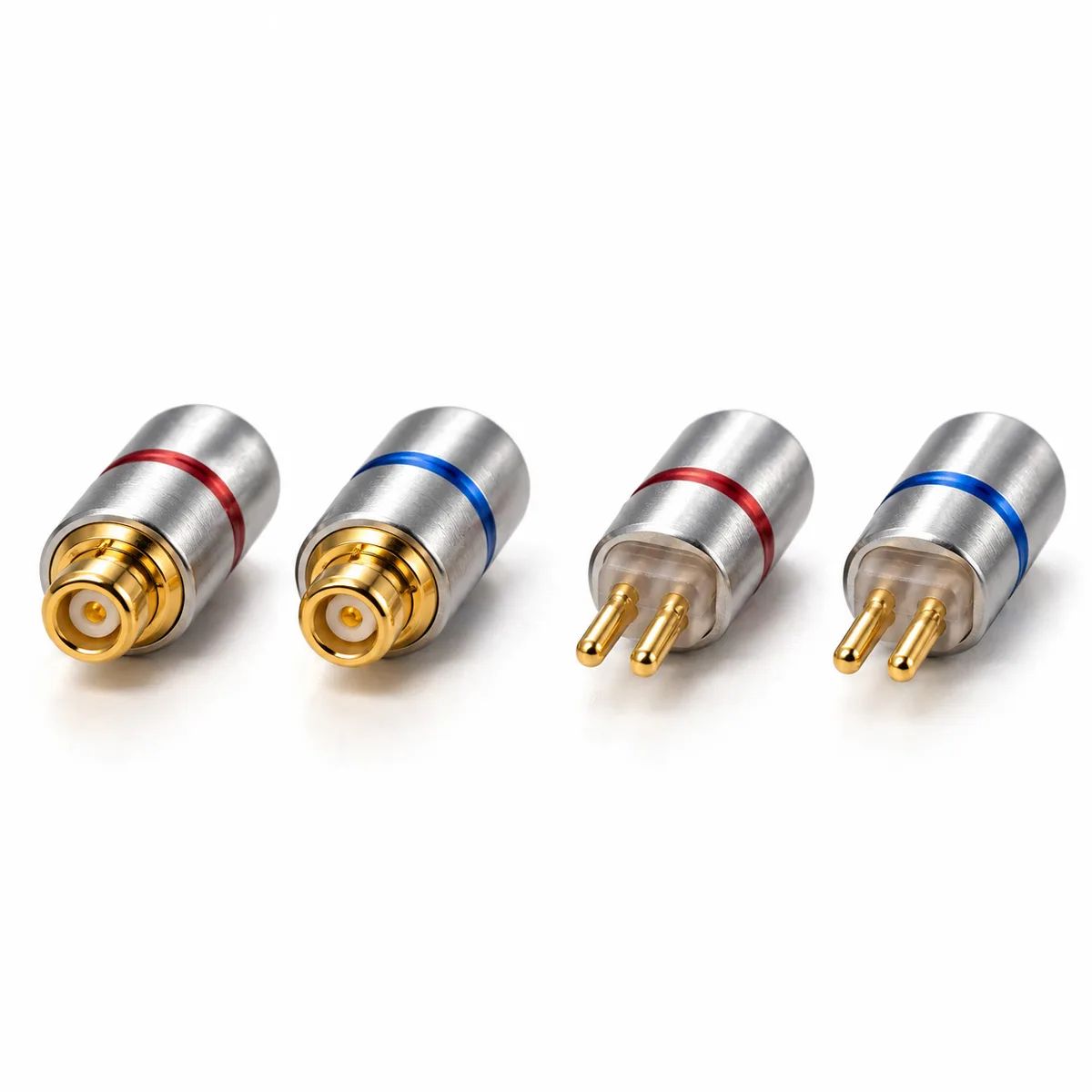
| MMCX | Micro-miniature coaxial snap-on connector, originally for RF use; rotates 360° once mated |
| 0.78 mm 2-Pin | Two parallel 0.78 mm pins held by friction; does not rotate |
| Interchangeable? | No. Each cable must match the IEM socket; adapters add length and an extra contact point |
| Main wear point | MMCX: the snap retention and contact springs. 2-Pin: pin straightness and socket grip |
| Main specification risk | 2-Pin: polarity and housing variant (flush, recessed or extended). MMCX: retention force and fit tolerance |
| Published standard | RF-grade MMCX: CECC 22000 family. 0.78 mm 2-Pin: no widely recognized published standard |
What is an MMCX connector?
MMCX stands for micro-miniature coaxial. It was designed as a radio-frequency (RF) connector: a center contact surrounded by an outer shell, joined by a snap-on coupling. RF-grade MMCX parts follow the European CECC 22000 specification family, and connector makers such as Amphenol RF rate them for a minimum of 500 mating cycles.
In an IEM, the same geometry carries an analog audio signal. In common practice, the center contact carries the signal for that earpiece and the outer shell carries the return. Each earpiece has its own MMCX connector, so a standard stereo cable has two.
Two practical points follow:
- Rotation. Once mated, the plug can turn 360°. This lets the cable follow the ear hook, but repeated rotation also wears the contact surfaces.
- "MMCX" on an audio part does not guarantee RF-grade MMCX performance. Many IEM connectors share the nominal interface but are not necessarily built or tested to an RF datasheet. Retention force and durability vary by source, so ask for test data rather than assuming the RF rating applies.
What is a 0.78 mm 2-Pin connector?
A 0.78 mm 2-Pin connector has two parallel pins, each 0.78 mm in diameter, on the cable side. They push into a matching two-hole socket on the IEM shell and are held by friction. There is no locking mechanism and no rotation.
Unlike MMCX, the 0.78 mm 2-Pin format has no widely recognized published standard that cable makers can cite. Pin spacing, housing shape and polarity marking follow common practice rather than a standard document, so housing variants exist in the market. Three are commonly described:
| Variant | What it looks like | Fits |
|---|---|---|
| Flush (flat) | Cable-side housing ends flat; pins protrude | IEMs with a socket flush with the shell |
| Recessed | Narrower housing that sits inside a recess in the shell | IEMs with a recessed socket; a flush plug may not seat fully |
| Extended housing | Housing with a protruding shroud around the pins | IEMs with a raised socket designed for that shroud |
Exact dimensions differ between parts sold under the same variant name, so confirm fit with a sample on the target IEM.
Some older IEMs used 0.75 mm pins. A 0.78 mm pin can be a very tight fit in a 0.75 mm socket and may damage it; a 0.75 mm pin in a 0.78 mm socket may be loose and contact intermittently.
MMCX vs 0.78 mm 2-Pin: how do they compare?
| Aspect | MMCX | 0.78 mm 2-Pin |
|---|---|---|
| Retention | Snap-on detent; positive "click" | Friction only |
| Rotation | 360° | None; fixed angle |
| Typical failure mode | Retention wears, or contact springs loosen, causing intermittent sound in one earpiece | Pins bend, or the socket loosens after many insertions |
| Polarity risk | Low at the connector: a coaxial plug cannot be inserted the wrong way round (the cable must still be wired correctly) | Higher; a plug with a symmetrical housing can be inserted either way round, so a marker is needed unless the housing is keyed |
| Variant risk | Low geometric variation, but fit tolerance varies by source | Flush vs recessed vs extended housing must match the IEM |
| Ease of frequent swapping | Fast to snap on and off | Needs a straight pull; repeated swaps can loosen the socket |
| Durability data | RF-grade parts: 500 cycles minimum on datasheets; audio-grade parts vary | No common published rating; depends on the part |
| Main specification items | Retention feel, contact plating, fit with reference IEMs | Variant, polarity marking, pin-to-housing dimensions |
Which connector is more durable?
Neither is universally more durable. Each fails in a different way, and part quality matters more than the format.
- MMCX problems usually show up as a cable that spins too freely, or as sound cutting in and out on one side. Both come from worn retention or contact springs.
- 2-Pin problems usually show up as a bent pin or a loose fit. A pin that is bent and then straightened is weakened.
For a product line, the useful question is not "which is better?" but "what evidence does the supplier have for this specific part?" Ask for the plating on the contacts, the retention or insertion-force figures if available, and any mating-cycle test with its method. Publish durability figures only if you have that data.
Why does polarity matter with 2-Pin cables?
If one earpiece is wired with reversed polarity, the two earpieces move out of phase. Commonly reported effects are weaker bass and a vague, unfocused center image. With a 2-Pin connector, this can happen in two ways: the cable is wired inconsistently, or the plug is inserted the wrong way round.
To prevent it:
- Define polarity in the specification. State which pin carries the signal relative to a visible marker on the housing. Dots, colors or "L/R" text are common markers.
- Mark left and right. Use a consistent convention, for example red for right, and print it in the user instructions.
- Check every sample. Check pin-to-pin wiring against the wiring table with a multimeter or cable tester, then confirm by listening on a reference IEM with a polarity (in-phase / out-of-phase) test track before approving production.
How should a cable brand choose between them?
Let the IEMs your customers already own decide. The connector is set by the earpiece, not by the cable.
| Your situation | Practical approach |
|---|---|
| Upgrade cables for a broad market | Offer both MMCX and 0.78 mm 2-Pin versions of the same cable as SKU variants |
| Cables for one IEM model or brand partner | Match that model's socket exactly, including the 2-Pin housing variant |
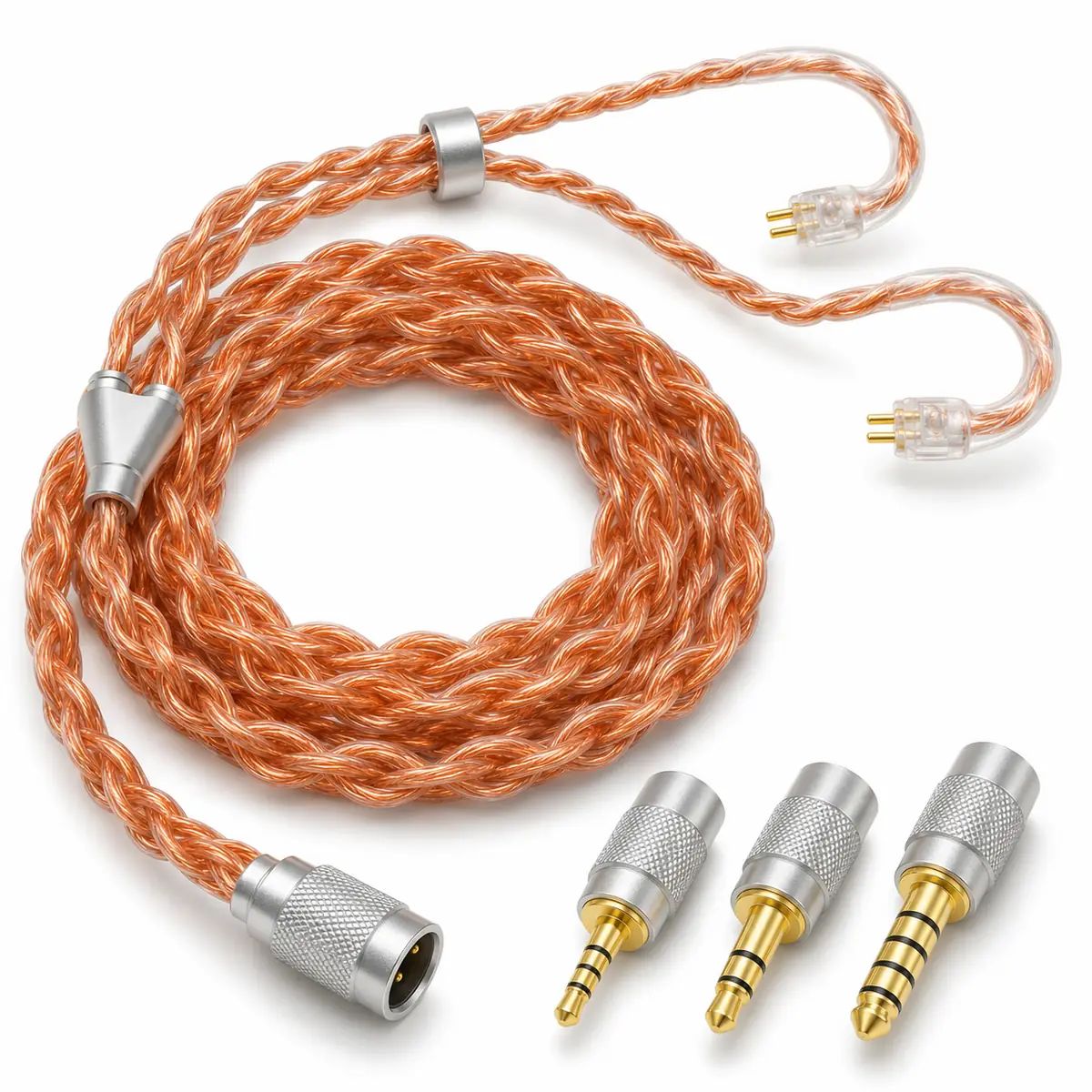
| Customers who switch between source devices | Pair either connector with a modular, interchangeable source plug (2.5 / 3.5 / 4.4 mm) |
| Cable workshop building to order | Stock both connector types plus braided core on reels |
On the source end, the 4.4 mm 5-pole balanced plug follows JEITA RC-8141C. The common assignment from tip to base is L+, L−, R+, R− and ground; confirm it in a wiring table for each order. Use 2.5 mm TRRS and 3.5 mm TRS plugs where your customers' players use those outputs.
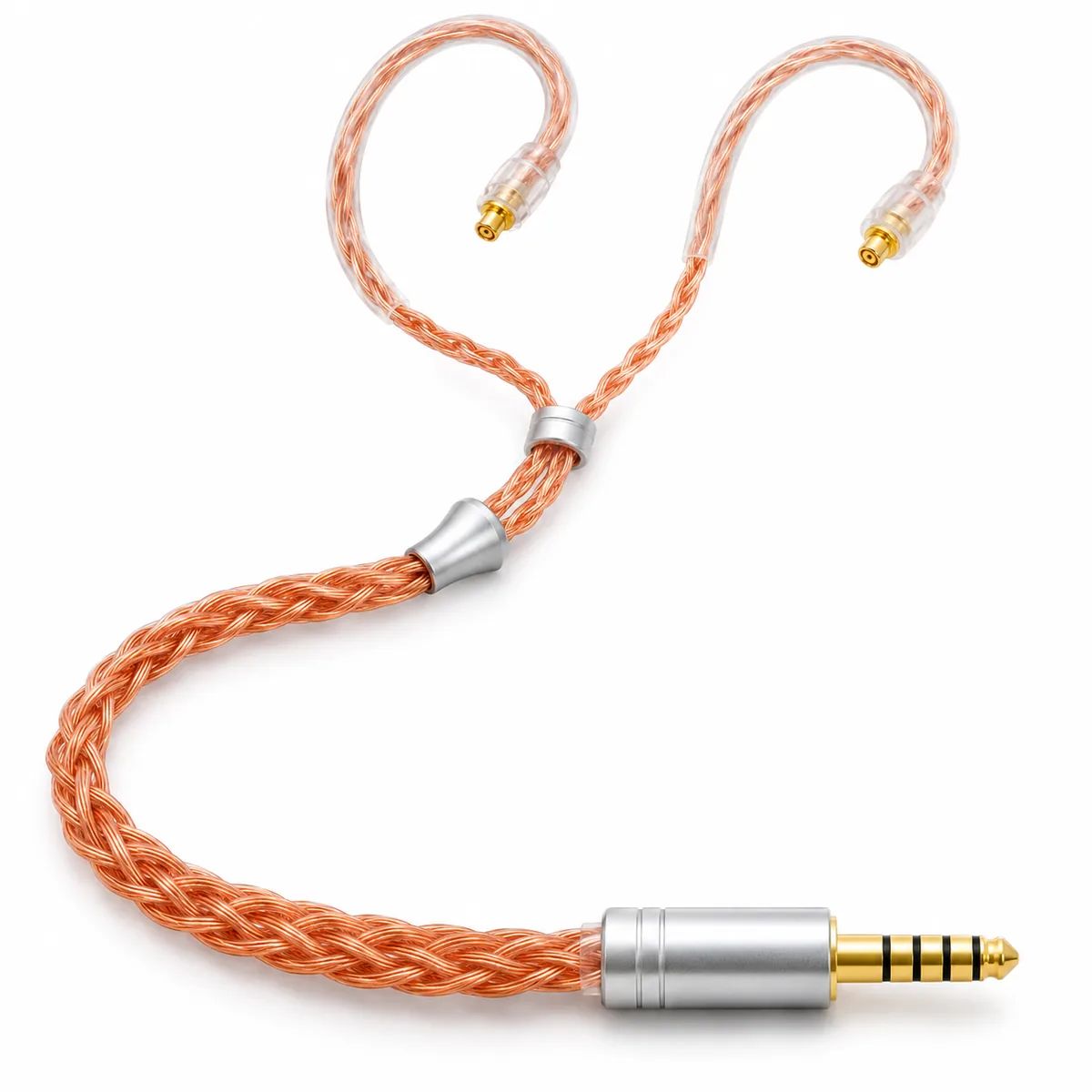
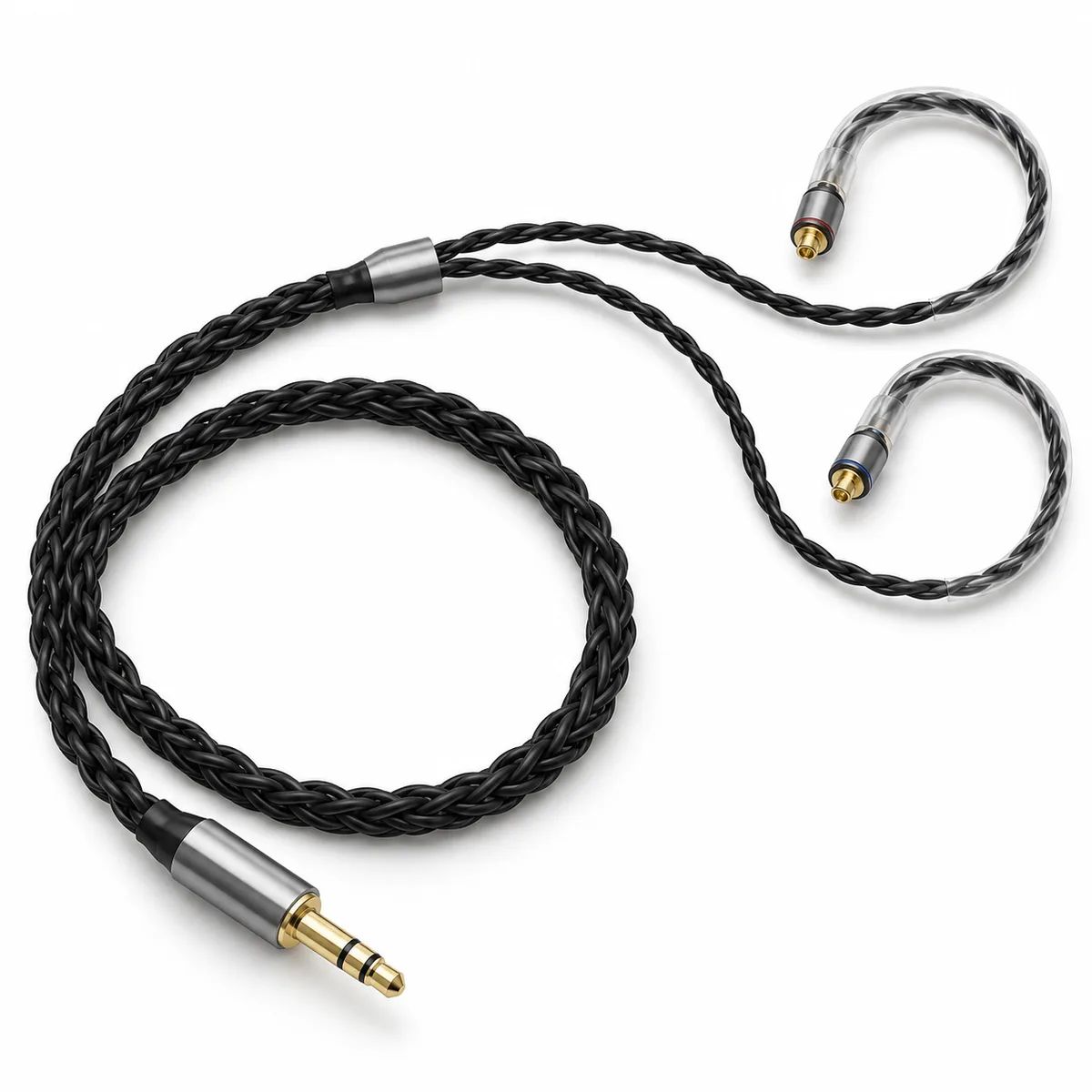
Product examples: the 8-strand braided IEM cable (MMCX or 0.78 mm 2-Pin), the modular headphone upgrade cable with interchangeable 2.5 / 3.5 / 4.4 mm plugs, and the 4-strand IEM cable. See all IEM upgrade cables.
What should you put in your specification when ordering IEM cables?
Write each item down. "Standard 2-Pin" or "normal MMCX" means different things to different suppliers.
- Earpiece connector: MMCX or 0.78 mm 2-Pin. For 2-Pin, state flush, recessed or extended housing.
- Polarity and L/R marking: which pin is signal relative to the marker; color or text for left and right.
- Connector angle and ear hook: straight or angled plug; pre-formed ear hook, yes or no.
- Source plug and pinout: 3.5 mm TRS, 2.5 mm TRRS or 4.4 mm 5-pole, with a wiring table for each.
- Conductor: state the material honestly (for example OFC or silver-plated copper). Claims such as OCC or 5N purity should be confirmed in writing on your order; if you need proof, commission an independent lab test at your cost.
- Number of braided strands and jacket: for example 4-strand or 8-strand, insulation material and color.
- Fit check: the reference IEMs to test against during sampling (kept internal; brand names are not used in marketing).
- Packaging and branding: logo position on the splitter or plug, and retail packaging.
Our standard 0.78 mm 2-Pin connector is the flush type; recessed and extended-housing versions are made to order, and fit is checked on a sample with your target IEM. Cable builders can source MMCX and 0.78 mm 2-Pin connectors, 2.5 / 3.5 / 4.4 mm headphone plugs and braided IEM cable core on reels from our plug kits and connectors range.
Building IEM cables or stocking connectors? Send us the connector types, variants and quantities you need. We reply with available options and a sample plan. Ask about cable materials and connectors
Frequently asked questions
Can I use an MMCX cable on a 2-Pin IEM?
Not directly. The connectors are physically different. Adapters exist, but they add length and an extra contact point at the earpiece. For a clean fit, use a cable made with the same connector as the IEM socket.
Why does my MMCX cable cut out on one side?
Usually because the snap retention or the contact springs have worn, so the connection is intermittent when the cable rotates. Clean the contacts and check the fit. If it continues, the cable connector or the IEM socket needs replacing.
What is the difference between flush and recessed 2-Pin?
A flush 2-Pin plug has a flat housing that sits against a socket level with the IEM shell. A recessed plug has a narrower housing that fits into a socket set below the shell surface, and an extended-housing plug has a shroud around the pins for a raised socket. A mismatched plug may not seat fully or may leave a gap, so match the variant to the IEM and check fit on a sample. Our standard 0.78 mm 2-Pin connector is the flush type; recessed and extended-housing versions are made to order.
Does the connector type change the sound?
When both connectors make good contact and polarity is correct, the connector type is a mechanical choice. Audible problems usually come from poor contact, intermittent connections or reversed polarity, not from MMCX or 2-Pin as a format.
Which connector should a new IEM cable brand stock first?
Check which connector the IEMs your customers use most often have. Many brands offer the same cable in both MMCX and 0.78 mm 2-Pin versions as variants of one product, so stock follows demand without doubling the design work.
Launching your own IEM cable line? Request an OEM quote